
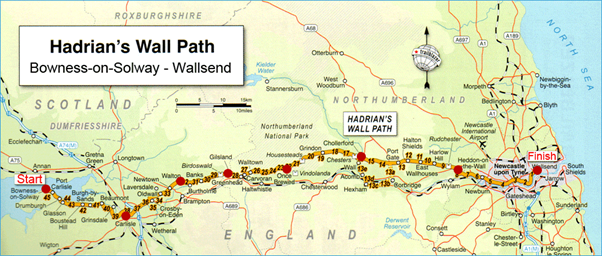
Freya Turner is 17 years old and was when she completed the Hadrian’s Wall walk with her mum and six other Anti Racist Cumbria members and supporters in July 2022. Here Freya shares her experience of walking the wall.
My Anti-Racist journey along Hadrian’s Wall July 2022.

Jo Turner & Freya Turner (mum and daughter)
Author: Freya Turner
I like walking with my dogs, my family and my friends. We will often walk over the Knott, through the woods and up and over a fell or two. So when a close friend of ours asked if I would be up to walking the length of Hadrian’s Wall- east to west: Bowness-in-Solway to Wallsend in Newcastle- I thought ‘ Yes! How hard can it be?’
2022 marks the 1900th year of Hadrian’s Wall and many cultural and historical events have been taking place in Carlisle and other locations along the length of the wall. The walk I took part in was organised by Anti-Racist Cumbria (ARC) and M-Unit.*
Our aim was to highlight and celebrate black and brown stories in the towns and spaces along the wall throughout history. We were a small team of 8 walkers added to here and there by friends and supporters of ARC, not to mention a TV and Radio crew.

Ready for the off!
Day 1
I was apprehensive when we set off early on that Friday namely because I had no idea what challenges lay ahead nor did I know many of my fellow walkers. It did not take long before the enormity of what I had agreed to dawned on me – as well as the raindrops which lashed down and gave us all a good soaking in the first few hours.
At Burgh-By-Sands we visited the place of Britain’s first African settlement. The plaque by the church reads:
The first recorded African community in Britain guarded a Roman fort on this site in the 3rd century AD.
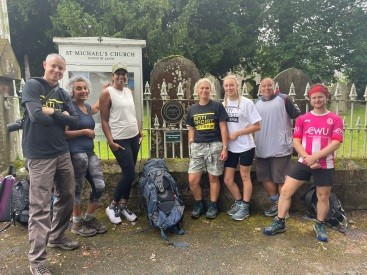
Burgh-By-Sands
There is compelling evidence by archaeologists that a 500 strong unit of Moors from North Africa manned one of the forts in the wall near Carlisle during this time and it is likely that once disbanded some stayed on with their families.
In a community book exchange near the Northumberland border we left some literature by black authors. It is important that the voices of black and brown people are heard and their stories are available to a wide audience in all communities.
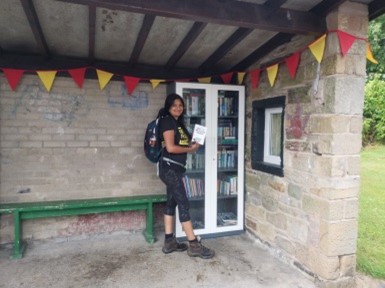
An innovative book swap!
My take away moment from the day was when we crossed an ancient battlefield, now farmland with grazing sheep. There was something other-worldly leftover in that field along with the scars of ditches that had hidden soldiers. We all felt the presence of the past as we walked.
The bunkhouse on that first night was a welcome retreat after 26 miles. The farm was rustic and we had to queue for the single shower but it was hot and a warm fire dried out walking boots overnight. We shared some Indian food and slept well despite aching legs and the knowledge of an early start.
Day 2
What a wall!The landscape changed dramatically on the second day, all agreed this was the most scenic part of the walk – rugged and unchanged for centuries. It is also the longest stretch of the wall still standing with the remains of Roman Mile castles dotted at regular intervals. Here also was the highest point of the wall at Windshields Wall – the views were spectacular though we felt very exposed to the elements, clouds were forming and the winds were strong.
We called in at Birdoswald Roman Fort and visitor centre and were met by a representative of English Heritage. Here we had some very welcome hot soup and chatted to some American tourists – teachers from New York, who were walking the wall in the opposite direction. They were very interested and supportive of our Anti-Racist message and shared their own experiences and stories. We left some Anti Racist Cumbria stickers and literature here and continued on our way.

Sycamore Gap.
The Sycamore tree gap is a well -known marker on the route. It stands alone in a dramatic dip in the wall and is said to be one of the most photographed trees in the country. It is also famous for appearing in the 1991 film ‘Robin Hood Prince of Thieves’.
This section of the walk consisted of lots of short climbs and descents which became unrelenting as we ate up the miles. The route really took a toll on our bodies and with an unfortunate deviation late in the day that meant extra miles of marching (like actual Roman soldiers) on a never-ending tarmac road. We finally made it back onto the relative comfort of moorland only to be terrorised by a herd of young cows determined to prevent us making it to our bunkhouse before dusk!
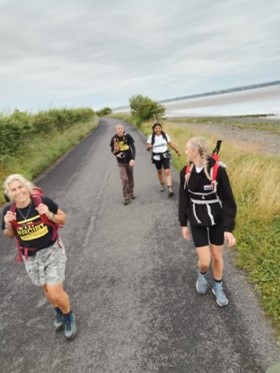
Pounding the tarmac.
Up to this point I had escaped the blisters and pressure sores but as I peeled my socks off before bed I could see my feet were in a sorry state and I was starting to worry that they would not last the journey.
Day 3
If the day before had been hard it was nothing compared for what lay in stall for us on the final leg. Before we could set off we all had to administer first aid to our feet! Every last compeed patch was used up as we prepared ourselves for the final assault.

Up and over
We left the wide open countryside behind as we headed for the outskirts of Newcastle and the landscape flattened and became urban. What kept our spirits up was how much we talked as we walked. The miles underfoot had made us friends and we shared stories and encouragement. It seemed that there was always someone struggling and someone singing – we took turns in falling behind and strolling ahead – it really was an emotional roller coaster in parts.
As we entered Tyneside we saw more people and the message blazoned on our t-shirts got noticed. People were encouraging; they wanted to know who we were and what we were about. Some even offered to buy us a pint! We were walking through one of the most deprived areas of the city late on Sunday evening when we past the doors of a pub with a reputation of being a Nationalist and racist meeting place but we were determined and held our heads high as we passed by.
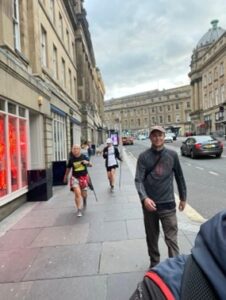
So close, yet so far.
Nearing Wallsend with still 5 miles to go we were all really struggling and we were definitely running on empty but I knew that having come this far I would not give up. The finish line for us was marked by the few remaining corner stones of wall in a place where the first stones were laid. The sense of accomplishment we felt as we completed the walk did not overwhelm us immediately, instead there was a quiet acknowledgement amongst new found friends that we had done what we came to do and we were grateful but too weary for words.
We had walked over a marathon each day (just over 90 miles in total) and slept in bunkhouses that offered little in the way of home comforts so our final night was spent in the Mal Maison, Newcastle. I had been looking forward to the luxury of a hotel with comfy beds and a spa and the thought of it had kept me going towards the end but the reality was we were so tired and aching that we literally crawled into our beds with paracetamol to numb the pain.
The final night I was both exhausted and exhilarated by what I had achieved and knew that long after the aches faded and the blisters healed I would not forget the strength and determination I had summoned to complete the walk. I feel this is something I will be able to look back on and remember when times are tough because I now know what I am truly capable of.

Done and done!
*If you want to find out more about the work of these two organisations and maybe get involved or lend your support follow these links:
Anti-Racist Cumbria is a registered charity organisation with a mission to make Cumbria the first anti-racist county in the UK.
https://antiracistcumbria.org/
 M-Unit – is a Carlisle based community interest Company that provides opportunities for people of colour and celebrates Black and Brown role models.
https://www.munitcarlisle.co.uk/
