

Anti-racist education need not be a solitary journey: an evening with Penrith and Eden Refugee Network
Karen Lockney, Niall McNulty, Jamie Penquite-Green
Anti Racist Cumbria volunteers wear hoodies and tshirts with our bold yellow and black logo and our statement of intent, ‘Making Cumbria the UK’s first anti racist county’. There isn’t a system where volunteers do some reading and study, take a test or submit an essay, and then get awarded a t-shirt to proclaim them a certified Anti Racist. Rather, we are committed to a process of learning and to sharing that learning with others. Sometimes this is challenging, in fact you could say that unless it is challenging, it probably isn’t going to have sustainable impact to bring about change in individuals’ outlooks and actions, and ultimately bringing about lasting change in society. However, ARC is also committed to making spaces where that challenge can be experienced in supportive, educational and warm-hearted environments, spaces where people can feel safe to talk with honesty about their thoughts, life experiences, to disagree perhaps, to question others but also themselves.
Creating Safe Spaces
Such was the space created last Friday in the Evergreen Hall in Penrith, when PERN (Penrith and Eden Refugee Network) held a dinner for their members and supporters – coming together to eat delicious food and engage in conversations about anti-racism, led by the Chair of ARC Trustees, Niall McNulty, along with volunteers Karen Lockney and Jamie Penquite-Green. Many thanks to PERN for bringing together around 40 people on a Friday evening (battling March snow in some cases), to be willing to talk about challenging terms: white privilege, white saviourism, colour blindness and anti-racism. However, it also shows the strength and commitment of both ARC and PERN that this could be done in such a warm atmosphere, helped along significantly by amazing Syrian food from Walaa’s Syrian Kitchen, who catered for the event.
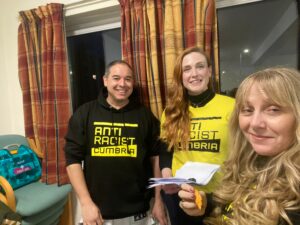
Our facilitators: Niall, Jamie & Karen
Thinking Deeper
The purpose of this blog is not to define or discuss these terms (there are other resources on our website you can look to, to find out more), but to convey the depth of thinking that took place. As volunteers we have watched the ARC video which contextualises the experience of Black and Brown people in the UK and in our county many times now, but it never fails to move us, and we experienced this again to contextualise our discussions. The statistics for hate crime and for health inequalities are stark. The quotations from Cumbrian residents’ and visitors’ experiences are chilling. This stuff is real, and it is unfortunately part of the fabric of Cumbrian life – for us all, never mind for those who are newly arrived, seeking asylum and a new life here.
Getting Comfortable with our Discomfort
After the video, we moved to discussions on our tables, each facilitated by an ARC volunteer, and by Sarah Wilson, chair of PERN. Together we talked about our level of confidence using the chosen terms, our possible disagreement with them. This produced rich conversations, honest reflections, sometimes -as is necessary – uncomfortable moments. For example, in relation to white privilege, people reflected on voluntary work they had done overseas and how that was set up with a sense of ‘saving’ people suffering; people admitted to not having challenged racism in the past; we heard of how upset a Cumbrian pupil had been to have her name repeatedly mispronounced by teachers who had known her for years; we thought about how many of us had never been followed round a supermarket thinking we were going to nick anything, never having been stopped by the police to check we owned our car. We talked about the question, ‘Where are you from?’ and how microaggressions such as this produce a cumulatively hurtful effect on Black and Brown people, in a different way to that in which most white people receive such questions, or are asked them. We watched videos where anti racist campaigners explain the terms we were discussing, such as Nova Reid’s powerful litany of examples of white privilege. We talked about the fact that latter term is controversial, something the current government in 2021 said should not be taught as fact, and we debated the extent to which we agreed with this position. The experiences shared on the tables suggested white privilege was a pretty uncontested fact from where we all were sitting, and for many of us had been our whole lives.
What Next?
The point of these conversations is not to provide easy answers. There is no take away crib sheet, no tick list. The point is to ask more and more questions, of each other and of ourselves. The point is to ask: what next?
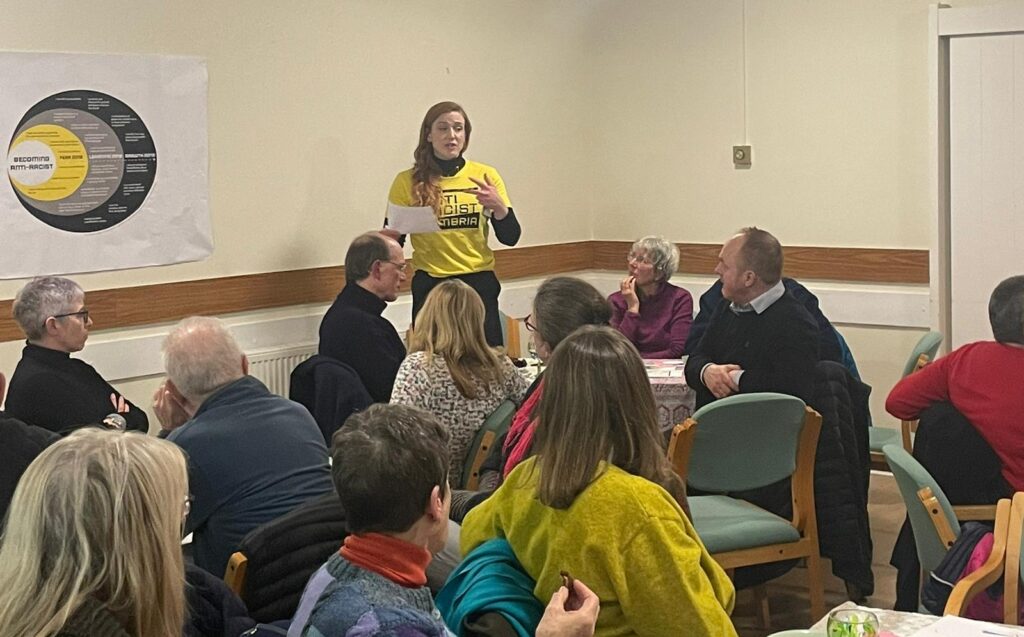
Sarah Wilson drew the evening to a close, asking what next for PERN. She had brought along a selection of great books about anti-racism and allyship. Sarah spoke honestly that the concept of white saviourism is definitely one for PERN to interrogate. PERN is a majority white organisation – a group of dedicated people who wish to help refugees and people seeking asylum, and which does fantastic work in this area. ARC supports this work, and campaigns on immigration issues, but does not work with refugees and people seeking asylum directly (though some of its volunteers also do this work) – therefore we are also keen to listen to the experiences of our PERN friends, and learn from these. We spoke on Friday of the contrast between a group of predominantly white volunteers who often have a strong, established voice in their communities, who are advocating for a group with no tangible status in UK society, trapped in a broken asylum system and an increasingly hostile environment. The contrast is significant, and white saviourism is a route down which no-one wants to go. An understanding of white privilege, of colour blindness and anti-racism can only strengthen the work of PERN, as of ARC, and have impact on the people this is really about – not those of us sharing dinner on Friday, but the men, women and children in hotels in Carlisle, and taking up residency around our county. We talked about how we need to move on from guilt or self doubt, themselves aligned to privilege, and how we all benefit from critical friends to ‘check’ our practice.
As volunteers facilitating these discussions, we want to thank PERN for such a warm welcome. We were left feeling hopeful and looking forward to hearing about how the conversations will turn into Anti Racist actions. It is in the willingness of every person in the room to show up, assess, engage and to agitate ourselves, and in those conversations and education, that ultimately make our communities stronger through collective accountability and resistance.
