
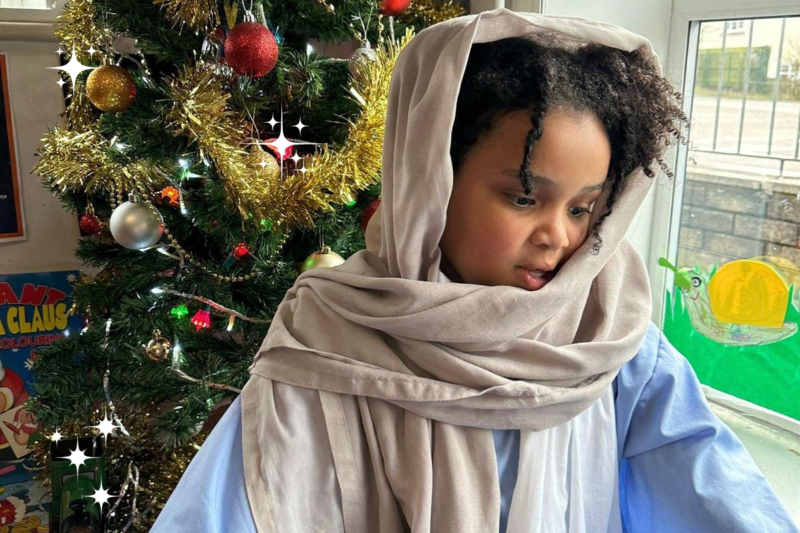
If you’re a parent or carer in charge of making a costume, or you’re hearing your little angels practicing their Christmas songs on loop, we don’t need to tell you that it’s the season of the nativity play!
They are a rite of passage for lots of children, their parents and loved ones, a tradition many of us also did as children, and its familiarity can be comforting… and really damn cute!
So let’s be clear before you read on, we are NOT out to cancel Christmas! We know that a big part of a school Nativity is finishing off the year with something fun that all the children and their families can enjoy after a long term!
But at the same time…traditions (particularly ones with as much cuteness and nostalgia as a nativity!) can lead us to overlook things we usually wouldn’t…like the ways that cultural norms such as racism have been baked in.
Conversations about how racism can show up in nativity plays often meet defensiveness, partly because many of us have an emotional connection to them: “This is the way we’ve always done things!”, “It’s just a bit of fun” or “we can’t do anything anymore!”.
But anti-racism is an all year round activity! By simply reconsidering how we approach the classic nativity play, teachers and parents can ensure they don’t inadvertently teach children racist stereotypes, or potentially harm some children and families. Remember, racism isn’t about intent, it’s about harm, and most of us want to make sure all children are able to enjoy the festivities at school!
To help us explore this we asked some of our expert ARCtivists as we’re lucky enough to have headteachers, teachers, and even the RE Advisor to Cumbrian SACRE in our midst!
Appropriate Costumes
The old classic tea towel and rope round the head seems to have remained a staple on stage for shepherds and the three kings. But instead of going with this because it’s what’s always been done, there is a great opportunity here to explore historical dress and religious clothing in a deeper way with the children, honouring traditions from different regions and religions.
Using a beautiful fabric (a rummage in a charity shop can reveal loads of options) teachers can run a lesson making the headdresses together. This takes pressure off parents to source and create costumes, and avoids what can feel like a disrespectful way to depict people from Bethlehem, which is now in Palestine. If you’re not sure how using a tea towel could be disrespectful, ask yourself: when else, other than during a Nativity, is it ever socially acceptable to depict people from this area of the world with tea towels as head coverings? If an adult did this, wouldn’t it feel a bit racist? A bit problematic? By brushing this to one side ‘because it’s a Nativity’ we are sending confusing messages to children.
Making the head coverings is a great opportunity to take some time and care to explore place, dress, and religion with the children. We can be more respectful and give the children more context about what the nativity story is about.
Representation
In many nativities, Baby Jesus is depicted with pale white skin, blue eyes, and light hair. An easy way to push back against this racialised misinformation is by representing baby Jesus as he most likely was, a baby from Bethlehem! You can get dolls with different skin tones cheaply and easily, and this is such an easy ‘quick fix’ if you’re floundering about where to start. Plus it can be re-used year after year!
Another thing to consider is how skin colour is playing out in who gets to play certain parts. We’ve heard from parents about how it’s often the pale-skinned blonde children to be cast as Mary or lead roles such as angels, with darker skinned children being relegated to being ‘extras’. Some schools avoid this by drawing shortlisted names out of a hat and making sure everyone gets their chance to shine on stage!
Now let’s talk about Balthazar, one of the three kings who is often depicted as Black.
In recent years, there has been more exploration around how the depiction of Balthazar as a Black African began. He was usually depicted as white, until the 1400s which coincided with the rise of the trade in enslaved African people. To learn more you can read an introductory article published to accompany an exhibition at The Getty in LA, “Balthazar: A Black African King in Medieval and Renaissance Art”.
In an interesting article on her personal blog, Professor Patricia Roberts-Miller explores this further. She writes about how what might seem like modern inclusivity (representing the kings with three different skin colours) actually has roots in racist re-readings of Genesis XI.
”“Genesis IX involves Noah’s three sons, and racists read that passage as God’s creation of Africans, whites, and Asians…reading and portraying the wise men as three–a white, African, and Asian–was part of back-reading Scripture to legitimate the notion of three races, and the notion that one was condemned to servitude”
~ Professor Patricia Roberts-Miller.
When there is only one Black or Brown child in a class, this role is often kept for them, but there are so many different roles available and it can feel othering and harmful to always be type-cast as this role. Especially when the links to this wider history are considered.
Avoiding Assumptions…
When planning a nativity, there can be a lot of assumptions about how the school community feels about the story, how it’s told and their religious beliefs. Our education ARCtivists advise engaging with families first, spending some time questioning how and why the play might be being approached in a certain way. Tradition is important, but if this is being done at the detriment of everyone being able to enjoy it and get involved, there might be ways schools can re-look at how they approach their nativity next year.
At the end of the day, it’s about making sure every child and every family is able to get involved and enjoy the festivities at school!
If you’re looking for more ideas, advice and support here are some helpful links:
Maslaha: An anti-racist approach to teaching Awareness Days – Christmas
Center for Racial Justice: A Racial Justice Guide to the Holiday Season
Anti Racist Cumbria: 4 Cumbrian Christmases!
The Conversation: The Long History of how Jesus came to resemble a white European
Reflections on Christmas by Tiny Travels: Helping children understand the true meaning of Christmas
