
Guest Article written by Donya Jeyabalasingham
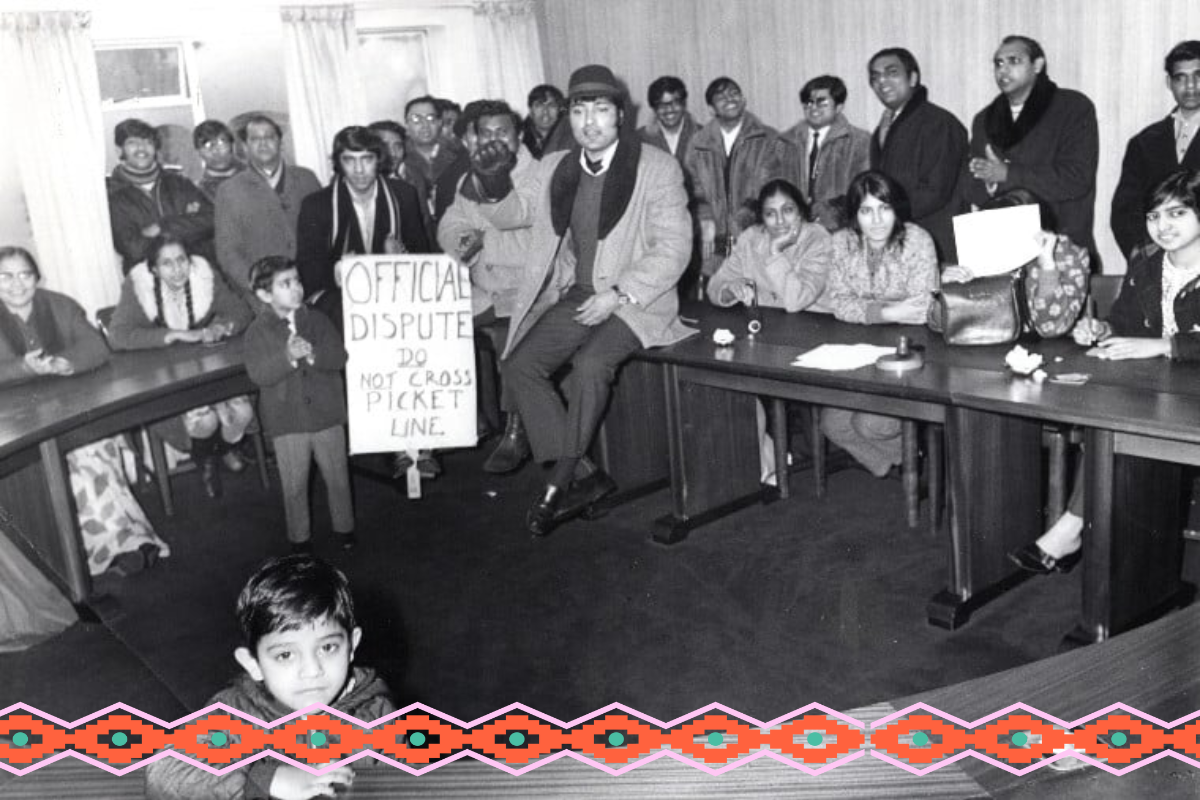
The Mansfield Hosiery Strike, Leicester, 1972
The heat of the past Summer led me to stores in London I’ve walked past a hundred times and taken no notice of. Not too long ago, I was driven to a place called Taj Stores, tucked along Brick Lane, in search of a cool drink and some shade. Like many other South Asian stores around the east end, the floors are lined with deep orangey-red tiles, and shelves packed with everything from fresh jackfruit, to steel pots, to (what I was really looking for), bottles of Thums Up. If you’ve never tried the Indian answer to the Coca-Cola, I highly recommend seizing the opportunity, if you can.
I found out that Taj Stores is special for reasons beyond stocking Thums Up – it’s actually the longest-established Asian greengrocers in London, having opened for business back in 1936. It hit me afterwards that places like that are the living proof that South Asian presence in the UK can be traced much further back than the post-war period, despite the fact that so much of British Asian identity is related to being a first or second generation immigrant.
Rozina Visram’s important work ‘Asians in Britain, 400 Years of History’ tells us, in fact, that British South Asian history goes all the way back to the beginning of the 17th century. The first settler communities can be traced back to the early 19th century onwards – with particular concentration in Cardiff, Liverpool and the East End of London.
It is still true that the most significant numbers of migrants from South Asia began to arrive and settle in the UK under the British Nationality Act 1948, during the post-Second World War period of labour shortage. The exporting of ‘cheap labour’ to fuel growth in post-war Britain embedded these migrants right into the British working class.
Working class history is glossed over in British curriculums, if acknowledged at all. Black and Asian working class history is close to non-existent. Our parents and grand-parents have passed on the bulk of their experience through oral history – but trauma from living through racism and violence on British streets throughout the 60s, 70s and 80s has made talking about what happened a difficult thing to do, and much of today’s British South Asian youth will be unaware of what struggles were endured, what victories were won, and the methods of resistance that were built to defend our communities from racism in the workplace and beyond.
Recently, the anniversary of the great Grunwick struggle went by. Usually we hear about this dispute which was a protracted action that, at its high points, saw mass mobilization across the labour movement and working classes in support of South Asian workers. Despite the cultural climate of the 1970s, differences of race and gender were put aside. Local postal workers, miners and shipbuilders (predominantly white men) travelled to the site to join the Asian women workers on strike – out of a common rejection to injustice at work. Yet, despite boycotts from other industries, the backing of 154 unions and even a recommendation from a government inquiry to reinstate sacked workers, the strike eventually failed. Crucially, the workers were eventually abandoned by both the TUC and APEX (their union) and their demands were left unmet. Even though the strike is today heralded as a heart-warming story where there was widespread support for Asian workers, Grunwick should shed light on how racism was an inherent feature of British trade unionism in the post-war era.
If you take a look at the Asian workers’ struggles of the post-war period that came before the Grunwick dispute, such as the Imperial Typwriters strikes and, as is the subject of this article, the Mansfield Hosiery Strike, the institutions of the trade union movement largely abandoned (or attempted to abandon) Asian workers.
What’s remarkable is that despite this, the workers transformed their own situations, with solidarity, collectivism and the principles of dignity, decent work and fair pay.
Leicester and the South Asian Working Class
The independence of Kenya and the Ugandan crisis in 1972 are two historical events which greatly contributed to the increase of South Asians from East Africa in the UK from 45,000 in 1971 to about 180,000 in 1981.11,00 Ugandan Asian refugees migrated to Leicester in 1972 following expulsion. Despite the fact that they were British passport holders with no home to go to, they were met with a response that many of us will recognize in present day treatment of incoming people seeking asylum.
Their arrival came soon after Enoch Powell ‘Rivers of Blood’ speech where he framed incoming Black and Brown migrants as posing a mortal threat to the English identity and white British communities. Memories of the 70s and 80s will be marred by the racist rioting that took place which brought terrifying attacks and violence to Black and Asian communities across the country.
The hosiery mills were large employers in the East Midlands – with an increase from around 50,000 jobs in 1911 to 77,000 in 1939. The hosiery industry also gave Leicester its reputation of being a ‘women’s’ city’ due to the work available for women in these mills. But (as usual) ‘women’ implicitly conjures up images of white women, and the significant contributions of South Asian women – who were twice as likely to be working than their white counterparts – to this industrial heritage.
The initial postwar years to 1951 were ‘relatively prosperous’ for the hosiery industry. But, technology changes, among other factors, eventually led to structural changes, leading to employers attempting profit maximising interventions like doubling the number of shifts per day to aid competitiveness – a story we know all too well in the present day. The increase in international competition resulted in inferior pay, extended working hours and subsequent Mill closures. From January to May 1971, there were fifty factory closures and at least 2,000 redundancies.
In the Mansfield hosiery mill, Asian workers comprised half of the overall workforce, yet in skilled roles there were only 5 non-white workers. Unskilled roles were predominantly taken by workers of South Asian origin. The way these discriminatory practices were put in place was the creation of an industrial culture that privileged experience, talent and expertise. It also benefited employers looking to save money to keep Asian workers on piece-rate contracts.
The racist presumption in the Mill was that the Asians simply lacked the relevant skills, knowledge and talent to take on skilled roles – this type of thinking was commonplace at the time, and based in an inherent racism about the intelligence and capabilities of immigrants.
The ‘racial biases’ of the employer and union were backed up by procedural rules that ended up having racist outcomes. Like much of the institutional racism of the present day, rules can appear to be neutral, but can have insidious effects when applied across diverse groups of people, you’ll quickly see that specific groups have different outcomes to others. For example, in the hosiery mill, qualities such as long-term union membership and length of service were prioritised, which essentially created a system of better jobs being reserved for white people.
What happened at the Mansfield Hosiery Mill?
The feminist magazine Spare Rib reported on the atrocious treatment of the Asian women workers at the mill. Management often refused to call them by their names, ignored their grievances, disapplied workplace procedures, overused disciplinary action and suspensions with cuts in their pay. Even the structures of pay subjugated the Asian workers – where white women were on an average wage, most of the Asian women worked on a ‘piece-rate’ basis. It’s important to remember that even to this day, BME workers are more likely to be in ‘insecure work’ and zero-hours contracts. Just as it was in the past, by exploiting these insecure forms of pay and employment, employers force workers into precarious, low-paid labour with high rates of in-work poverty. In situations where work was deemed too difficult by white workers at the mill, the job was then shifted to piece-rates and given to Asian workers who had to then work much harder to earn enough income. There were also reports of at least one South Asian woman, the victim of persistent harassment from a supervisor, being told she could not wear her sari to work.
The better jobs on the knitting machines were essentially denied to South Asian workers, who predominantly took cutting roles and work equipping the machines with thread and wool for the knitters. Though this was less valued work, it was reported that without them, production at the Mill fell by around 70%– a reality that became a serious problem for the employers.
The strike itself was triggered by a u-turn taken by management where they had, following protest from Asian workers, previously agreed to train 2 Asian workers in a higher skilled and higher paid role. Instead they offered a token pay offer, with no promise of training –an insulting offer that formed the straw to break the camel’s back.
Fed up with the division of labour on racial grounds, the rough work with pittance pay and the racism expressed by management and fellow workers, 50 women and between 250-320 (conflicting reports) men made the decision to walk out, forming the beginning of the strike outside Trinity Street factory. Initially their strike was not supported by the union, the NUHKW, but within twelve weeks they won on their key demand of training for higher paying jobs.
How the strike was won?
The New York Times called the dispute Britain’s ‘first major industrial dispute’ in which race has emerged openly as an issue as well as the first major victory by Asian immigrants through industrial action. While this isn’t true, there were a handful of disputes in the 60s that did predominantly concern Asian migrants, it was true that the Mansfield Hosiery strike represented a significant success – not only because better conditions and pay were won, but also because the dispute came to the attention of the Race Relations Board who criticised the racialised division of labour, as well as triggering a Government Inquiry. Different factors influenced its success:
Marginalised Working class solidarity:
Three days into the initial strike, a further 80 Asian women from the Clarence Street factory also came out in sympathy. The size of the strike began to shake the union, as well as the militancy of the workers – the workers on strike displayed immense solidarity to each other even in the face of significant loss of wages and social security payments.
Solidarity is one way we can explain why this strike was so successful, but it’s a word that can have very different meanings. Researcher, Wayne Medford, thinks of solidarity in two ways:
“One conception of solidarity is as a quality of individuals forming close-knit communities, based around shared values and geography. Another is as a shared ethos, forming one party to support another in need, to address a crisis or social injustice, through attentiveness and some self-sacrifice.”
What we are seeing today is an attempt by the far-right to revise British working class history into a struggle that is informed by racial solidarity amongst the white working class. This is where telling ‘untold’ stories plays an important and political role, because strikes like this show us that solidarity based on conditions, worker power and participation, in opposition to exploitation, is what has historically been successful.
Many will remember the raft of anti-trade union laws that came in under Thatcher’s tenure as Prime Minister, one of the most damaging changes was the ban on sympathy action – which means removing the ability to take industrial action in solidarity with other workers where you are not directly involved in the dispute. Many of the strikes of the 20th century up to the 80s were powerful because of the use of sympathy actions across the country, forming a deep-rooted working class solidarity that was equally empowered through the withdrawal of labour- to use the well-known trade union motto ‘an injury to one is an injury to all’. Within the working class Asian communities in Leicester, similar solidarity was being built – and would ultimately become organised in the subsequent Imperial Typewriters strike that soon followed.
‘Racism? I did not know there was a problem of racism’ Taking the fight to the Union
The above is a quotation from the NUHKW (Knitwear Union) General Secretary, Harold Gibson – encapsulating the wilful blindness from the top that the Asian workers were dealing with. When the Union initially refused to support the workers on strike – it was understood that part of this fight had to be taken to the Union.
Research by Marc Collinson showed that The National Union of Hosiery and Knitwear Workers was known for adopting local hostile attitudes towards migrants and initially were determined to crush the strike, going door to door to convince strikers to return.
Despite representing the Asian workers, leaders of the knitwear union did not make their responsibilities to the workers clear, and across the trade union movement as a whole there were implementations of local tactics such as colour bars and restrictions of promotion opportunities that prioritised white British workers. The Race Relations Board found that in this case the trade union, NUHKW, ‘connived with the management’ to prevent Indian workers’ advancement in training.
Solidarity came from other Black and Asian activist and anti-racist groups. Notably, Bennie Bunsee, a student anti-racist activist and South African political exile, took on a consultant role to the South Asian strikers as he believed that the trade union movement had abandoned their cause. He reported on their tactics – which included occupying the ‘lush NUHKW union offices’ and applying significant pressure to trade union reps until December, where the union conceded in recognising the strike and entered into arbitration with the employers.
One of the things to come out of this strike was the Mansfield Strike Committee, which included trade union branches, activists, workers and support from Black political groups, which went on to form a major conference in Birmingham 1973, a conference that the creation of the National Committee for Trade Unions Against Racism is attributed to.
‘We will not go back like dogs’ The Aftermath
After 12 weeks, the strike resulted in victories with South Asian workers receiving training to be knitters, a role that was previously exclusively performed by white workers, as well as the formation of a shop committee that consisted of 15 representatives, 11 of which were South Asian.
The relationship between English and Asian workers changed to some extent following the strike – Bunsee reported that ‘problems like pricing of articles are discussed together. Swearing has stopped. Asian women are given a wages slip- this was not done before. Some of the Asian women are now trying to learn English and some of the English women know a little Gujarati.”
The Mill strike is less cited among Asian worker strikes in 70s Leicester, mainly because the most significant was the Imperial Typewriters – described by Ron Ramdin (historian and novelist) as the ‘apotheosis of race strikes’–where fewer concessions were won but the activity of South Asians within the British working class were to be forever changed.
In the present day, anti-racism is on the agenda for most trade unions. The UK’s largest trade union, Unison, despite its Labour party affiliation, recently passed a raft of policy motions opposing the second class treatment of migrant workers in response to the Government’s deeply concerning anti-migrant rhetoric. Precarious and low-paid work runs rife in present day British society and Black and Asian workers are disproportionately affected by this – BME women are three times as likely to be on zero-hours contracts in comparison to their white male counterparts.
Politicians continue to frame the working class struggle as opposed to or distinct from the struggles of migrants and minoritised peoples in the UK. Their arguments have barely changed from those waged 60 years ago. The lessons of the past serve a greater purpose than conscription to ‘history’–but rather they are blueprints for fighting for a better future. The Hosiery Mill strike deserves recounting because it tells a story of Asian workers transforming their own situations, quoting from the Mansfield Mill workers – “we will not go back like dogs”.
