
The Türkiye-Syria Earthquake
This article was written by Esme Bayar, a Turkish-Cumbrian living in Türkiye’s capital, Ankara.
On the morning of Monday 6th February while people around the world turned off their alarms and started getting ready for another week at work or school, a living nightmare began for people in Türkiye (formerly Turkey) and Syria who woke to the news that a 7.8-magnitude earthquake had hit the southeast region of Türkiye.
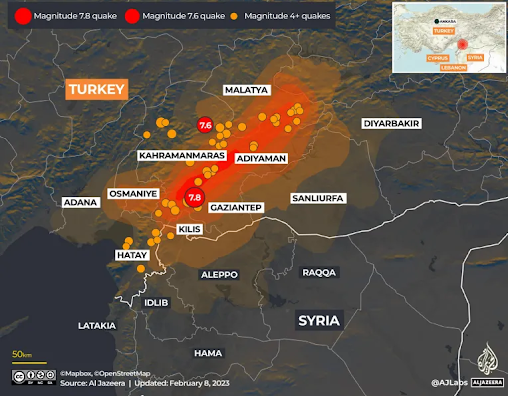
Caption: The area affected spans over 280 miles – for a sense of scale, that is roughly the distance from Brighton to Newcastle. The World Health Organisation estimates a total of almost 26 million people have been affected across both countries.
From the first images and videos emerging after the earthquake, it was clear that the earthquake had caused mass destruction on both sides of Türkiye’s border with northwest Syria. As search and rescue efforts began, they were hampered by aftershocks that continued throughout the day with a second huge earthquake of 7.6-magnitude striking within 12 hours from the first.
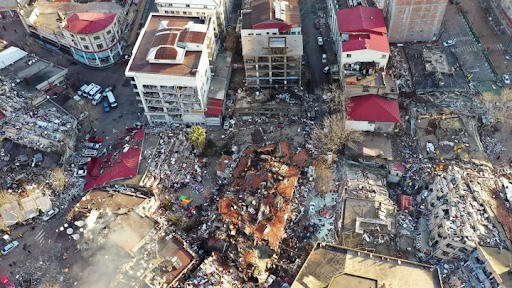
Caption: An aerial photo from the city centre of Kahramanmaraş, close to the epicentre of the first earthquake. (Photo by Evrim Aydin/Anadolu Agency via Getty Images)
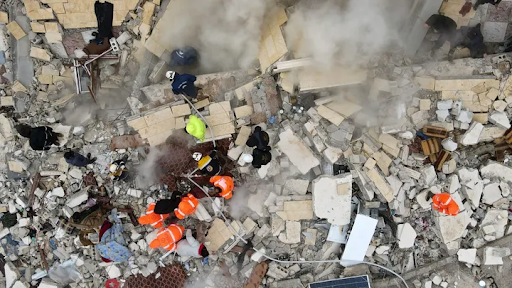
Caption: Residents in the town of Sarmada in the countryside of the northwestern Syrian Idlib province, searching for victims and survivors in the rubble of collapsed buildings (Photo by Muhammad Haj Kadour/AFP via Getty Images)
In Türkiye phone lines and internet connections were immediately down across many of the areas hit due to damage to infrastructure and intense call traffic as people tried to reach their loved ones. This hindered the rescue effort and caused many to fear the worst. Countless Instagram stories and tweets asked for information on whether the friends and relatives of those sharing were still alive. Others begged for help to be sent to people they knew were stuck under rubble. These posts shared the names and addresses of those missing, often including photos showing their smiling faces in happy family scenes and graduation photos.
Search and rescue teams flew into Türkiye from around the world to work side by side with local state and NGO specialists. Teams of miners joined the efforts using their expertise in tunnel-building to reach those trapped while civilians pulled away at the debris with their hands and listened for the voices of survivors. At the time of writing 7 days on from the first earthquake, hopes of finding survivors have faded. The official combined death toll for Türkiye and Syria stands at over 33,000, and the chances of finding survivors after a week of freezing cold temperatures are increasingly slim.
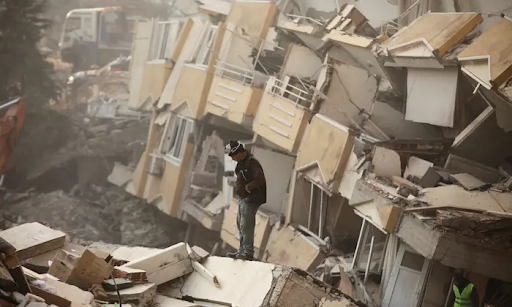
Caption: A view of some of the damage in Kahrmanmaş. Photograph: Stoyan Nenov/Reuters
Every so often there is news of a miracle. Many have shared the uplifting video showing the joy of the crowd as they cheer for a family of 6 that has just been rescued from the rubble in the Syrian village of Besnia. In Türkiye a video of 6-year old Zübeyde has gone viral as rescuers reached her after 61 hours spent lying amongst the ruins of her home in Kahramanmaraş. She asks how they got into her house to which one rescuer jokingly replies that they climbed in through the window and have won the game of hide and seek.
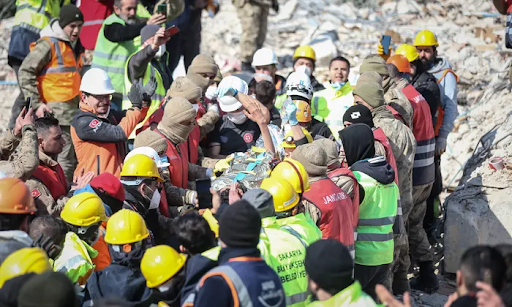
Caption: A 13-year-old boy is rescued after 128 hours under the rubble in Antakya in the Hatay province of Türkiye (Photograph: Anadolu Agency/Getty Images)
For everyone watching, these videos are bittersweet. They offer hope that there are more who can still be saved, and demonstrate the bravery and dedication of the rescue teams who – despite working day and night in the most difficult of conditions – still do their best to reassure survivors as they wait to be freed. At the same time it is heartbreaking to wonder whether the survivors’ families and friends have made it out.
On both sides of the Turkish-Syrian border the pain is indescribable. With loved ones lost and homes destroyed or unsafe to enter, the physical and psychological wounds left by the earthquakes are irreparable. For the millions of Syrian refugees in southeast Turkey and internally displaced persons living in northwest Syria, the earthquakes have been a traumatic reliving of the civil war – for many of them it will not be the first time that their home has been destroyed. For all those who managed to escape the falling buildings, it is unlikely that they will ever forget the voices of survivors screaming to be rescued from underneath the rubble or the fear caused by the prolonged and violent shaking of the two huge earthquakes and their aftershocks.
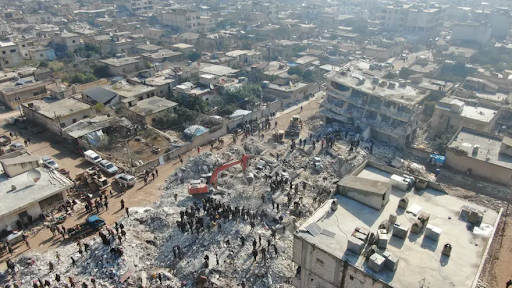
Caption: Search and rescue efforts in Jindires, Syria. Photograph: Anadolu Agency/Getty Images
Recovery efforts in Türkiye are underway with state authorities, NGOs, and volunteers working to establish needs and hand out supplies to survivors. Sports grounds and public buildings have been converted into makeshift camps, temporarily providing shelter to families until they can be housed somewhere with a little more warmth and privacy like containers that will be purchased through donations or student dormitories that have been emptied to house those affected.
While some needs, such as food, water, and shelter may be immediately obvious to the average observer, others are perhaps less so. Securing public health and hygiene is a priority – without an adequate supply of portable toilets and sanitation facilities there is a high risk of waterborne diseases spreading. With temperatures dropping to -5 degrees Celsius, heat is another critical issue – across the region affected, thousands have been keeping warm by sitting in their cars to the extent that petrol is now difficult to find in the cities worst-hit by the earthquakes. Many people are having difficulties accessing life-saving medication and materials, for example, gluten-free food products for those with celiac disease. Coordinating logistics to meet these diverse needs is a huge challenge given not only the scale of the devastation but also the damage that it has caused to vital infrastructure including ports, roads, and airports.
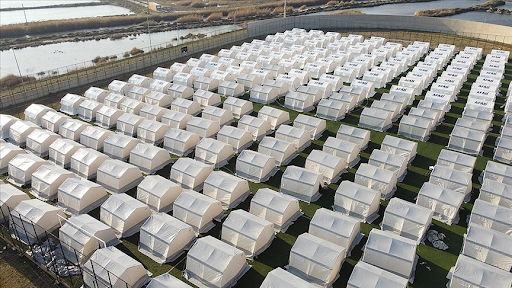
Tents set up to house survivors in Hatay. Photograph: Anadolu Agency/ Sebahatdin Zeyrek
This has exacerbated the problem of getting crucial aid to northwest Syria as Türkiye is the main entryway to reach opposition-held areas. Those affected by the earthquake in Syria feel abandoned as the supplies of food and materials are even more limited than in Türkiye. A complex web of political problems and sanctions already made the provision of humanitarian assistance to Syria via government-held areas extremely difficult. These barriers have also affected the accessibility of international search and rescue teams, and for this reason the majority of the rescue efforts in opposition-held areas of northwest Syria have been carried out by local volunteer teams such as the Syria Civil Defense, otherwise known as the White Helmets.
Despite the collective despair, the displays of solidarity have been immense. Social media in Türkiye have been filled with posts from people offering to help in whatever way they can – hotels providing rooms to homeless families, local restaurants opening up to provide bread and soup to survivors, digger and winch operators offering to operate the machinery needed to lift the heavy wreckage.
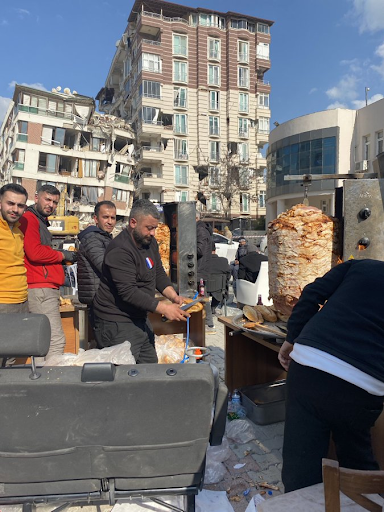
Caption: A group in the city of Diyarbakır, Türkiye, set up a makeshift kitchen to supply those out in the cold with chicken “döner” sandwiches. Photographer unknown.
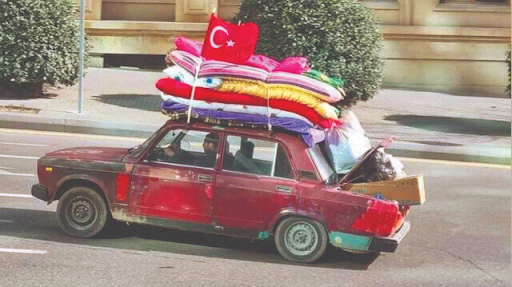
Caption: Photos of Server Beşirli, a citizen of Baku, circulated social media after he collected donations from his friends and family and drove from Azerbaijan to Turkey to deliver them. Photographer unknown.
Those who are further away from the worst-hit areas are also doing their utmost to help. A group of university students used their web development skills to set up a platform to coordinate relief efforts while animal-lovers are sharing posts to find adoptive homes for pets who have lost their families. Despite an economic crisis and 3-figure levels of inflation, collection centres and lorries are being filled with in-kind donations. One image from a collection centre in Türkiye showed the scrawled handwriting of a child who had stuffed a note inside a pair of gloves he had donated – he wrote that he had emptied his piggy bank to help the earthquake survivors and wished he could send more.
His note reflects the feelings of millions across Türkiye and Syria and around the world who are watching this disaster unfold from a distance, all the while wishing they could do more. Many share a sense of guilt and shame to go to sleep in the comfort of their beds knowing that hundreds of thousands of people are out in the cold while others lie in the ruins of their homes.
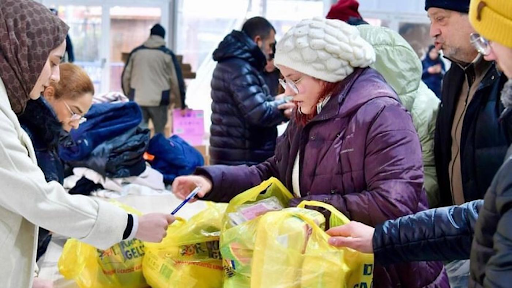
Caption: Volunteers in Istanbul preparing essential items for those affected by the earthquake (Photo: İrem Danalıoğlu, shared on Middle East Eye)
It is understandable that many feel helpless given the scale of this tragedy, yet there is still a great deal that can be done to support those in need in Türkiye and Syria. Raising awareness, donating items, and sending cash to charities are all valuable contributions to the collective effort. Given exchange rates, ₤10 can go a long way towards covering urgent needs for supplies, such as food, water, tents, and heaters as well as the more long-term needs that will later have to be addressed, such as bursaries for children who have lost their parents and mental health and psychosocial support for survivors.
How you can help
For those who would like to and can donate, a list of charities active in the Türkiye-Syria earthquake response can be found below. Petitions have also been opened to campaign for the opening of aid routes to Syria as well as the creation of a Turkish Family Scheme visa to bring homeless survivors of the earthquake to stay with relatives in the UK.
Ahbap is an NGO that is working to support disaster relief efforts in Türkiye through a wide and fast-moving network of dedicated volunteers. https://ahbap.org/bagis-kategorisi/5
AKUT is a voluntary NGO deploying search and rescue teams, and raising awareness around disaster preparedness in Türkiye. https://www.akut.org.tr/en
Choose Love is a UK-based NGO working to support refugees around the world. They partner with local charities on the ground in Türkiye and Syria including the Syria Civil Defence also known as the White Helmets. https://donate.chooselove.org/campaigns/emergency-earthquake-appeal/
British Red Cross is working with the Turkish Red Crescent and Syrian Arab Red Crescent teams to support the rescue efforts and provide humanitarian relief. https://www.redcross.org.uk/about-us/news-and-media/media-centre/press-releases/british-red-cross-launches-turkey-syria-earthquake-appeal
