

Part I
What do you think of when someone mentions racism?
Often people are quick to talk about hate crime.
But when someone mentions the words ‘hate crime’ what comes to mind?? Maybe offensive language, or beating someone up because they are ‘x’ ‘y’ or ‘z’?
But does this cover the whole meaning of what racism is?
We are going to get into this more later on but for now, pause and sit with your thoughts before reading on.

Take a breath in, and a long breath out…
When ARC are invited to meetings, workshops, strategy groups or panels, the conversation tends to focus on better hate crime awareness, reporting and policing, almost as though these actions are the solution to racism.
“We need to promote what hate crime is and increase the number of people reporting!”
“We need to collect better data on hate crime and speak to those it’s happening to”.
We’ve become very familiar with these conversations and they happen in almost all of the spaces that we are invited to.
But is focusing on hate crime really the solution to tackling racism that many think it is?
Hate crime law is based on the 1960’s Race Relation Act which was fought for by Black and Brown led activist campaigns (read our post here on instagram for more details) and watch this BBC documentary Black Power: A British Story of Resistance. In 1998 and 2003 ‘hate crime’ offences were introduced.
The definition of a hate crime, as stated by The Crown Prosecution Service (CPS), is:
“Any criminal offence which is perceived by the victim or any other person, to be motivated by hostility or prejudice, based on a person’s disability or perceived disability; race or perceived race; or religion or perceived religion; or sexual orientation or perceived sexual orientation or transgender identity or perceived transgender identity.”
Although the legislation does not state this directly, hate crime, given the nature of the offence, only covers a very specific form of racist ‘incident’. Usually this will be very direct and obvious racism, like calling someone a racist slur or verbally or physically attacking them in a way which is obviously based on the victim’s race.
This ignores other forms of racism which are most often not recognised as racism at all. Forms of racism that have become so ‘normalised’ that they are deemed socially acceptable behaviours. This infographic might help you to begin to better understand what ‘normal’ or ‘everyday’ racism looks like and help you think about this further.
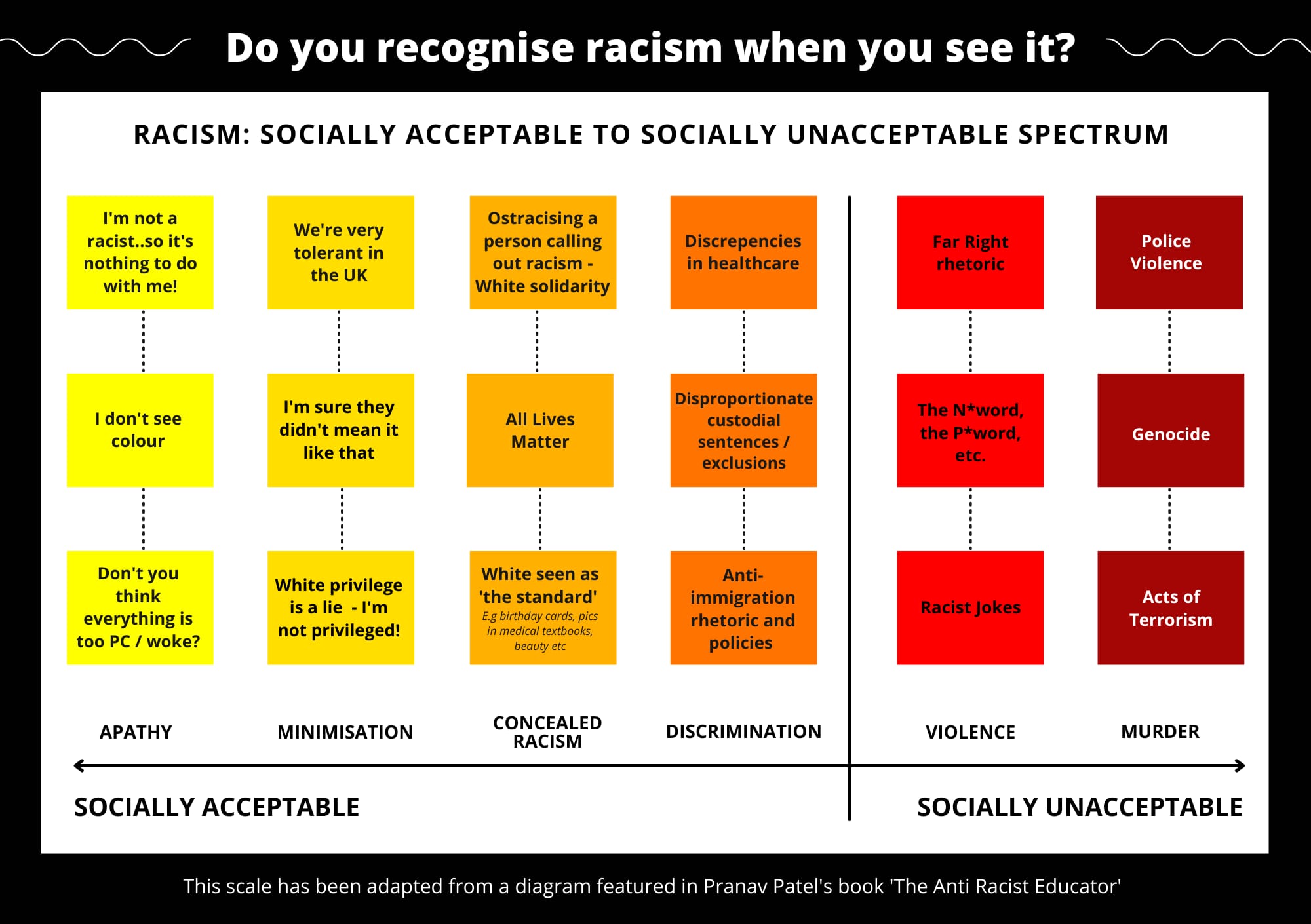 When hate crime is put forward as the main (or sole) solution to racism, energy is only being put into one small part of the problem.
Instead of taking a preventative approach, and really getting to the root of racism, intervention happens far too late when the extreme racist incident has already happened.
Hate crime doesn’t ‘tackle racism’, it deals with the aftermath of a narrow percentage of racist ‘incidents’ by punishing perpetrators. It does nothing to stop racism happening, and it does nothing to heal the racial trauma of the people who experience racism. If anything, the process adds to racial trauma as Black and Brown people are likely to be faced with other forms of racism (some of which show up on the infographic for instance) as they go through the reporting process and the judicial system.
This leads us on to another common issue. When using hate crime as a solution to racism there is much focus on the need to ‘raise awareness’ of what hate crime is, and how to report it.
Firstly, many Black and Brown people know when they have been the victim of a hate crime. Many don’t need their ‘awareness raising’ to understand what a hate crime is. As mentioned above, they live with everyday acts of racism, well, literally every day. There is an assumption that because Black and Brown people are not reporting, it is because they don’t know they have been a victim of a hate crime.
You might be thinking, if they know, why are they not reporting it then?
The elephant in the room is this: many Black and Brown people have very limited trust in the police due to the very well documented and evidenced racism in policing which has not been addressed.
Many have personally experienced racism in the way that they, or their friends and family have been policed. Stopped and searched, pulled over in the car, questioned if they ‘own’ the bike they rode as a child.
If you are a numbers person, just look at the most recent government statistics.
“In the year ending March 2023, there were 24.5 stop and searches for every 1,000 black people, and 5.9 for every 1,000 white people in England and Wales…Cumbria had the highest stop and search rate for the Asian ethnic group”.
Despite this, racism in policing is simply not part of the conversation when we talk about lack of trust in Black and Brown communities. On the occasions when the issue is raised ARC are often met with a reply that attempts to acknowledge a lack of trust, but diagnoses it as a problem Black and Brown communities ‘perceive’ in institutions rather than a real institutional racism problem which must be acted upon in order to regain trust. This is what leads people to point to ‘raising awareness’ as the solution. This might be enough if the problem of racism within the police force was simply just ‘perceived’, but this is not the case.
‘Raising awareness’ will never be enough. There have been many similar initiatives in the past and they have not been successful. Until the police do deep anti-racism work within their organisations to tackle racism, and show the public they are doing that, trust in the police in Black and Brown communities will remain low.
Another issue we notice when hate crime is discussed as a solution to racism is how focusing on hate crime enables people to avoid naming racism and addressing it head on.
This is where the majority of people in the room do not mention racism once even though that is the topic they are supposedly addressing. They skirt around the words and use words like ‘prejudice’, ‘discrimination’ or ‘hate’ instead.
Racism is a word which evokes strong emotions in people and makes them uncomfortable, but it is necessary to move past the discomfort in order to tackle racism effectively. Frustratingly, hate crime approaches have become an easy way for people to sidestep conversations about what racism is, which contributes to the devaluing and dismissing of racism as a problem, what it really us, and how we can meaningfully address it through anti-racism. This is a form of indirectly and unintentionally upholding racism.
Part II
We’ve split this article into two parts, so that those of you who want to take a deeper dive into what racism is really about can choose to do so. We know the issues are complex and people are at different stages, so this second part aims to take a closer look at concepts like ‘power’ and ‘reverse racism’ and explores the difference between ‘prejudice’ and ‘racism’.
Something which is very noticeable when looking more closely at the legislation mentioned above, is that it does not mention racism, or any specific form of oppression directly.
The focus of the legislation is on the motivation of ‘hostility’ and ‘prejudice’. By conflating racism with ‘prejudice’ and reducing it down to interpersonal forms of racism, with a clear ‘perpetrator’ and ‘victim’, the context of power and the way racism operates through systems and institutions is completely erased, and this can lead to things which are not racism being considered as though they are.
For example, prejudice against a white person* can be treated as hate crime and labelled as the popular term ‘reverse racism’. However, this is a misinterpretation of what racism is.
Racism is more than prejudice based on racialised characteristics such as skin colour, it is backed up by systemic racism in power structures and the context of hundreds of years of racist oppression and white supremacy. It is this very important context which makes something racism rather than prejudice.
A white person can experience prejudice in the form of verbal or physical abuse for being white, but this is not backed up by a history of oppression based on ‘race’ and by ongoing systemic racism.
They are not facing poorer health outcomes because they are white. They are not less likely to be selected for a job interview because they have a white sounding name. They are not more likely to be stopped and searched by the police because they are white.
They might face disadvantages for other reasons (e.g class, gender, sexuality) but they are not experiencing racism.
The complete erasure of the power and historical context of racism, is one of the most significant reasons that action to address racism which focuses too heavily on hate crime can be detrimental and a block to anti-racist change.
Another problem hate crime legislation poses is the focus on ‘hostility’. A barrier we often come across when we broach anti-racism with people is the idea that racism is always intentional and done hatefully. Racism is considered a rare and terrible thing only ‘bad’ and ‘horrible’ people do, and the focus hate crime places on hostility has reinforced this idea in the public imagination.
But it just isn’t true. Racism is not rare. It is so pervasive that most white people have said or thought racist things. Clutching a purse when a Black person walks by. Seeing Black women as ‘aggressive’ or ‘angry’. Assuming Black people are over-represented in prison because they are “inherently” more inclined to commit crimes than white people. Associating Brown, Muslim men with ‘terrorism’ or sexual predators.
We could go on.
Many people also participate in upholding racism in organisations and systems and again, this is not always motivated by ‘hostility’. It is often done unknowingly. Or, even when there is a knowledge of racism, people often continue to uphold racism due to a sense of apathy, ‘this is how things are done’, ‘it’s too difficult to change things’. Something as passive as ‘not seeing’ racism plays a significant role in upholding racism for example.
We said earlier in this article that the word racism can provoke strong reactions in people, and one of the reasons for this is because people associate it with being labelled a ‘bad’ person. We see this especially when working with people who are in ‘good’ professions (charity work, teaching etc.) or when working with individuals who have morality and liberal ideals at the heart of their identity.
But we need to move past understanding racism as something only a tiny minority of ‘bad’ people participate in. We need to move past skirting around the topic of racism by only talking about ‘hate’ and ‘prejudice’. We need to move past understanding racism as interpersonal, person to person racism, and completely removed from the context of power, history and white supremacy. We need to accept that racism is embedded within almost all organisations and institutions and happens within systems.
Until we are brave enough to do this, we are wasting valuable and precious time.
*For clarification on what we are referring to when we talk about ‘white people’ in this context go to the ‘what white is white enough’ section of this article.
