

We’ve been digesting the furore over Diane Abbott MP’s letter (the context of which is set out later in this article) and wanted to take some time to think before commenting. Why? Because it’s a complex issue and what happened just over a week or so ago demonstrates very clearly that as a society we do not yet fully understand what racism is and how it works. Nor do we understand the nuances between terms like ‘prejudice’ ‘antisemitism’ and ‘discrimination’.
There are many layers to the Diane Abbott situation; misogynoir (there’s another term for you – go look it up), the lack of grace she receives when she messes up, her swift apology making absolutely no difference, and the way in which she has been treated which has no regard whatsoever for the state of her mental health nor the consistent racism she herself has faced. Even in her own party. The 2020 Forde Report showed the abuse she received from Labour staff members, with WhatsApp messages between those members referring to her as ‘a very angry woman’, ‘repulsive’ ‘makes me sick’. The report referred to “expressions of visceral disgust, drawing (consciously or otherwise) on racist tropes, and they bear little resemblance to the criticisms of white male MPs elsewhere in the messages” in relation to comments made about Diane in the WhatsApp chats.
We could cry for her.
In any case, how the Labour Party deals with this, whether their actions are fair, whether she should be or will be expelled, are all arguments and conversations that have been had elsewhere. This article is not about any of that, our focus is on her comments and what her letter actually says about racism.
Diane wrote:
“It is true that many types of white people with points of difference, such as redheads, can experience this prejudice.
But they are not all their lives subject to racism. In pre-civil rights America, Irish people, Jewish people and Travellers were not required to sit at the back of the bus.
In apartheid South Africa, these groups were allowed to vote. And at the height of slavery, there were no white-seeming people manacled on the slave ships.”
Later in her swift apology she says:
“Racism takes many forms and it is completely undeniable that Jewish people have suffered its monstrous effects, as have Irish people, Travellers and many others.”
Yes, it was worded clumsily. Diane Abbott herself has said it was a draft sent in error. But what about the content? The underlying message contained in her words are not necessarily wrong but they are certainly too few to explain such a deeply complex issue.
When something is about prejudice
We’re pretty sure most people aren’t going to say that people with red hair face racism but seeing as it’s mentioned – let’s start with redheads. Redheads may have been bullied for the colour of their hair – that is prejudice undoubtedly. But they are not told their hair is inappropriate for school, are expelled because of it, or are told their natural hair is ‘unprofessional’ in the workplace – whatever that means. Also, having red hair does not make them more likely to be followed by shopkeepers, or be stopped by the police (Black people are 18 times more likely to be stopped and searched by the police than their white counterparts and are more likely to be handcuffed and tasered) and they are not 4 times more likely to die in childbirth. In short, people with red hair are not, ‘all their lives subject to racism’. What people with red hair face is prejudice.
Racism comes in many forms
Racism is still very much viewed as something violent, whether verbal or physical, done by, well,… ‘racists’. It’s also thought of as something that happens only on an individual basis, person to person. People not experiencing racism (like the redhead example) sometimes compare their experiences to people who do experience racism, with comments such as “people make fun of me too” or “I was bullied when I was growing up because of xyz”. Both of these experiences, whilst true and cannot be excused in any way, do not (a) result in the kind of statistics we mentioned above or (b) understand the structures and systems that allow racism to thrive and result in those statistics. So the first thing to understand in all of this is that not all racism happens ‘person to person’. As Diane went on to state in her apology, ‘racism takes many forms’.
The invention of racism
Well that’s a big subject and at some point we’ll do a full article on it, if you can’t wait, book a Conversation Workshop with us or ask your employer to, we talk about it in great depth during those. For now, we’ll try to keep it short, and say that what needs to be understood is that the idea of ‘race’ or ‘different races’ was an invention, created to justify the enslavement of African people and is not based on any scientific evidence. People were divided by colour so that the elite could retain wealth and hold power and status. Prior to the 1500s, race as we know it today – used to identify differences such as skin colour – did not exist like now.
Now, here’s the bit which is hard to get your head around, take a deep breath and go with it; if you want to understand, you need to sit with the discomfort and keep going.
The invention of race based on colour also created the invention of Whiteness as a concept.
Remember, race based on colour was created because the need for enslaved African labour became more pressing. Enslavement was powering not only industry but was quite literally building a new country for Britain – America.
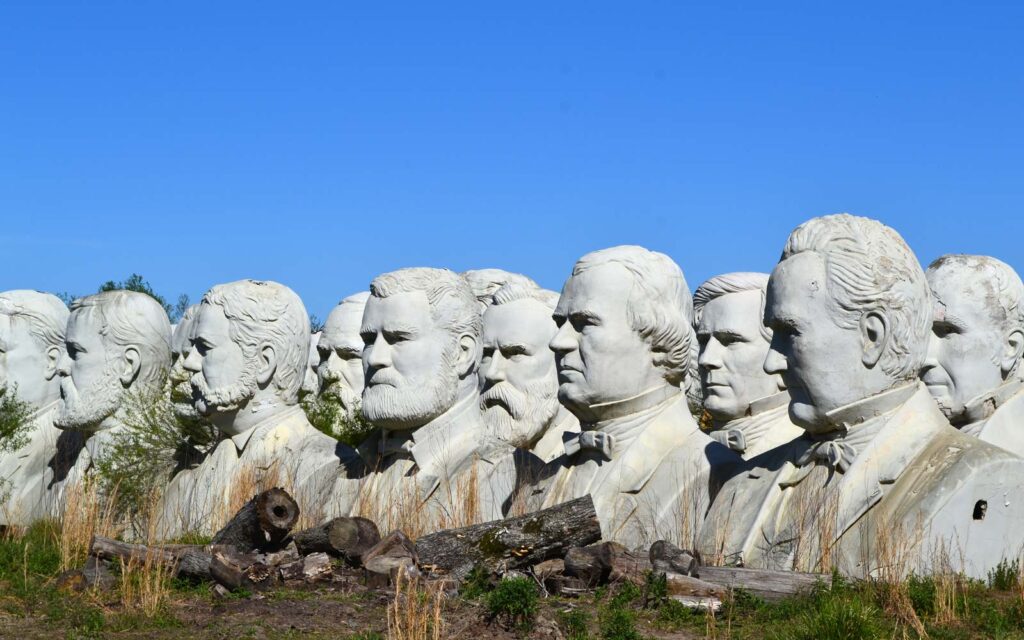
Statues of US presidents in Croaker, Virginia.
This new country was meant to be the ‘land of the free’ where ‘all men were created equal’ but it also needed to be able to continue to use enslaved labour, particularly enslaved African labour and therefore something was required that would ensure these new ideas of rights could not be extended to them. In the early days of enslavement, there were Black enslaved Africans and white European indentured servants slaving side by side and although there was a hierarchy in place, it clearly wasn’t based on skin colour; it was based on Christianity. Black enslaved Africans were not Christians and by the 1700s, the pressure of the constant fear of uprisings and rebellion by those enslaved, coupled with the ‘ready made steady supply’ of Africans being shipped via the dreaded middle passage, compelled plantation owners to give their Christian ‘servants’ legal (yes legal) privileges not available to the ‘infidel’ Africans. The difference in treatment, (however meagre) set the white Europeans apart, providing the slave owners with their allegiance and the indentured white Europeans with a sense of being ‘better than’ their Black enslaved counterparts. The idea flourished, supported by ‘pseudo-science’ that said Black people were inferior and over the centuries the false notion that white people were inherently smarter, more capable, more human became an everyday accepted unquestioned, not even thought about, fact.
White Supremacy and White Body Supremacy
Yes, we just entitled this next section ‘white supremacy’. It’s ok. Keep breathing and keep reading.
The division of people by colour beginning in the 15th century had multiple impacts that remain today; the elite clearly still hold the power and the wealth but what’s also really important to understand is that it provided a level of supremacy to all white people over Black people. Even poor white people. What the division did was to create the pitting of poorer people against each other; no matter how wide the gap between rich and poor, class tensions amongst white people were eased by the belief they all belonged to the superior ‘race’. This supremacy was preached in churches, literature, books, in fact everywhere around the world and it laid the foundation for British (and European) colonialism.
As time passed, there became a new take on ‘whiteness’. Being white had its advantages then as it does today. So when we say white supremacy, we are not talking about it in its most extreme forms of deranged folk in hoods, parading about demanding ‘racial purity’ involving the eradication of Jewish people, the enslavement of Black people, the subjugation of all other people of the Global Majority; the conversion or eradication of all non Christian religions and the elimination of impurities which include the LGBTQ+ community, people with a disability or neurodivergence, Gypsy Roma Travellers, and any form of ‘interracial’ relationships.
No, put simply, the white supremacy we are talking about is the one that has pervaded throughout society and sets ‘white’ as the norm, the ‘standard’ for human beings. It’s the white supremacy that believes that being white is better and places black people at the bottom and it is still ingrained in society today. This might be better termed ‘white body supremacy’. It’s often not conscious, not thought about, it just IS.
What white is white enough?
But it doesn’t end there…..
What has counted as ‘white’ has been and will continue to be flexible depending on the needs of power at the time. Let’s use the term ’whiteness’ rather than just ‘white’, because at times it’s ‘whiteness’ that has excluded Irish people who, on the whole, are white (some of those early indentured European servants were Irish for instance) and can continue to exclude Jewish people. Today whiteness definitely excludes Gypsy, Roma and Traveller (GRT) communities who certainly face some of the most overt and blatant forms of racism. We are constantly shocked at how openly and easily people abuse GRT people. The hatred of them is often palpable and entirely normalised.
Activists wear More Blacks More Dogs More Irish t-shirts.
It’s worth noting too that ‘whiteness’ can mean different things even in different places. In the US for example, note how Hispanic communities are excluded from ‘whiteness’ but in the UK people with Spanish heritage don’t face the same systemic issues.
So GRT people are generally white and Irish people are generally white. Yet both these communities have a long history of being oppressed, as do Jewish people. White supremacy (oh dear lord that term again) or white body supremacy is often used when we talk about oppression, but if white people can be oppressed too, then what does that mean for the definition of whiteness? Sometimes, is it the case that you are just not ‘white enough’? In much the same way that racism as a construct needs to be recognised and understood, so does Whiteness as an ideology. And fighting against ‘whiteness’ which is essentially the idea that white people (remember that’s flexible) are somehow inherently better and more deserving of humanity than people who aren’t.
Anti-racism essentially means to fight ‘whiteness’ as an ideology – not white people. Though of course those who are racialised as white need to step up and play their part in anti-racism, because racism is benefiting them whether they like it or not. We should all recognise that Whiteness can be used as a political tool that changes depending on its usefulness to whoever is doing the categorisation.

Trump’s political campaign – Build The Wall.
Anti-Black Racism
So to say that GRT communities and Jewish people don’t face racism would be wrong, but what this whole argument reveals is the consistent denial of anti-black racism and ignores that it unarguably leads to worse outcomes for Black people in society as a whole. Racism is not a race to the bottom.
But that does not mean that anti-Black racism and sentiment is not real. Anti-Black racism is about anti-Blackness and an acknowledgement that not all people who experience racism have the same lived experience. We can see from above that colonial ideas and stereotypes about Black people are still prevalent today.
To be clear, all kinds of racism are deplorable, but it must be recognised that racism can disproportionately affect certain groups at certain times. The statistics we note earlier regarding the stop and search on the part of the police are comparing the number of white people stopped to the number of Black people stopped – but look at this example;
Black people are 3 x more likely to be ‘stopped & searched’ than South Asian people.
So we can see from just one example that even people who face racism, do not necessarily face it in the same way. Racism is sometimes about more than just colour (we’ve just shown how the concept of ‘whiteness’ itself is flexible) but there is an undeniable truth that the darker the skin, the higher/worse the racist outcomes. To continually deny that fact allows racism in all its forms to continue, including antisemitism.
Antisemitism is alive and sadly well, and something we must be wary of and actively fight against. The rise of the far-right in recent years is well documented and a very real threat. However antisemitism’s current effects are different to anti-Black racism. The daily experience of a white Jewish person who is not visibly an Orthodox Jewish person is not the same experience as a Black Jewish person, and this would differ again depending on how they ‘present’ their faith. An Orthodox Jew’s ethnicity is visible and they may face horrible interpersonal racism, and suffer antisemitic views as a result of that visibility, however the stats bear out that Jewish people are not overrepresented in prison systems, or higher numbers of police deaths in custody for example. Two things can be true at once – Jewish people can face racism, but they (unless they are Black) cannot face anti-Black racism. In the same way that a Black person (unless they are Jewish) cannot face antisemitism. Jewish people continue to be subjected to prejudice and discrimination based on antisemitic tropes and conspiracy theories based on crude racist stereotypes, but the fact remains that a Black Jewish person would face a ‘double threat’.
So, yes there is antisemitism but it is different to anti-black racism.
In our view, Diane’s intention wasn’t to trivialise what Jewish people have gone through and continue to go through, nor do we believe she was trying to suggest that one crime (enslavement of African people) is more monstrous or worse than any other crime (the holocaust and the genocide of 6 million Jewish people). In our view, what she was trying to say, albeit badly, was that white skin Jewish people do not suffer racism in the same way that a person with Black skin does. That’s not antisemitic, it’s showing an understanding of anti-Blackness.
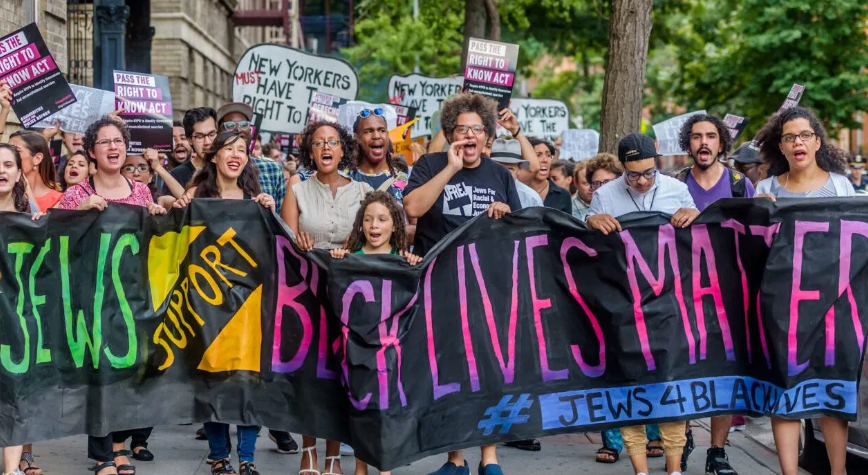
Communities advocating for each other at BLM protests.
Conclusion
It is beyond disappointing to see the reaction of so many communities to what Diane said. As marginalised communities we need to quit the in-fighting – it only divides us further and gives those with power even more power. When we react to things like this with our own ‘whataboutery’ and ‘outrage’ rather than trying to get beneath the rhetoric and understanding better, we become part of the problem – we actually submit to ‘whiteness’ as a divisive ideology ourselves. Let’s do better and stand together because we are all impacted by these divisions caused by deeply rooted beliefs about each other, which we all need to unlearn and work together to dismantle ‘whiteness’ and all forms of racism.
