
05.08.2024
The weekend may be done but the terror is far from over. We’re sick to our stomach. Our Black and Brown ARC members, our wider communities, our families, our friends: we are wired with anxiety and fear. We reel from the scenes of fascists marching the streets, the mainly white groups shouting Islamophobic hate-speech, attacking on Black and Brown people. Throwing bricks, smashing windows, setting libraries and community spaces on fire. And yet. We are not surprised.
There has been some condemnation of the violence, but a total failure from government, politicians and media to call out what this really is. Racist, Islamophobic, far-right attacks: it’s White Supremacy.
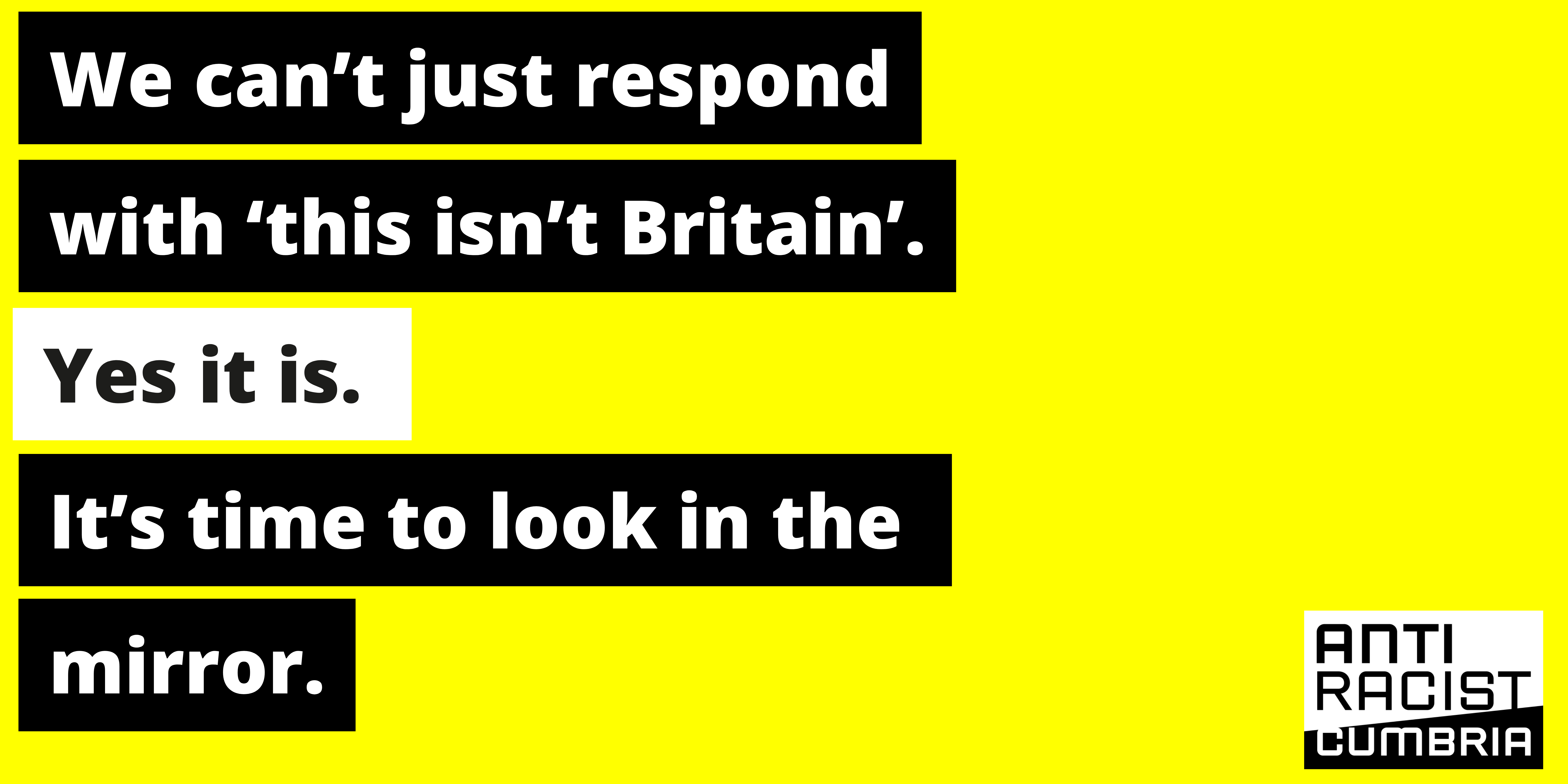
We have to face up to reality. These are acts of fascism. We respond with ‘this isn’t Britain’ at our peril. Calling out these individuals simply as ‘thugs’, ‘ignorant’ or other classist and ableist slurs not only plays into the division and violence, but dangerously underplays the many factors and influences that have led us to this point.
This is not something that can just be blamed on Stephen Yaxley-Lenon (Tommy Robinson) or the ideologies of Reform UK. It will not be enough to throw a handful of them into prison. It’s the tip of the iceberg. How many are uncomfortable with violence, but are quietly agreeing that ‘they have a point’? How many politicians, from every party, have relentlessly stoked the fire by using migrants as scapegoats? How many racist headlines are splashed across British newspapers or going viral online, unchecked?
Even if you don’t share the views of the fascists on our streets, what have you done to push for an anti-racist society? This is a wake-up call. It’s time to look in the mirror.
We cannot move past this as a country without accepting that we have a serious problem with racism, islamophobia and far-right radicalization.
We will be reaching out to local MPs in Cumbria to discuss how we can move forward from this. We urge you to act and to do the same, using our template below.
The only way we can face this is as a community. Together.
Check in on your Black and Brown friends. We are not okay.
Stay safe ♥️
Template for writing to your MP
Please personalise if possible to make it more impactful. If you are not based in Cumbria, remove the sections relating to Anti Racist Cumbria or Cumbria, and add in information about your area.
Dear _____,
I am writing to you as a constituent of ____.
I am horrified by the scenes of racist, islamophobic and far-right attacks which we have seen across the country.
These are not ‘protests’ or ‘thuggery’ but fascists marching the streets. Shouting racist and Islamophobic hate-speech. Physically attacking Black and Brown people. Targeting Black and Brown owned businesses and mosques. Looting and committing arson. Swarming hotels housing people seeking asylum. Throwing bricks, smashing windows, breaking in and rampaging, setting them on fire.
It is not enough just to imprison those who have committed crimes and dismiss them as a minority that don’t represent Britain. They are the extreme face of racism and islamophobia which has become normalised across our communities, institutions and systems and are just the tip of the iceberg.
Although much of the events this weekend have not (yet) been in Cumbria, there is clear evidence that this problem is rippling under the surface. In the last few weeks there has been a far-right leaflet circulated in Carlisle. In March, a Black boy was racially attacked by two white boys – the video going viral and reaching the national and international news. And these are just the ones that are in the public knowledge. Anti Racist Cumbria receive constant reports of racist incidents in Cumbrian schools – including in areas with small numbers of Black and Brown children.
I urge you to engage with Anti Racist Cumbria and address the root causes of these attacks: racism, islamophobia and far-right radicalisation in Cumbria and nationally.
Anti-racism must be a local and national priority.
Regards,
(Name)__________.
(Address)__________.
06.08.2023
We are seeing widespread attempts to dismiss the racist, islamophobic, far-right fascists as ‘thugs’ who are ‘mindless’, ‘thick’, even ‘r******’ (a slur term to refer to a disabled person).
This is eugenics terminology. Classism. Ableism. Systems of oppression which cannot be separated from racism.
People aren’t perpetrating this racist violence because they are working class. Because of their intelligence level. There are a lot of different factors which have brought us to this place, but we have to stop making excuses.
We live in a society which enables and encourages people to be racist.
Racism is rife across our communities and at every level of society, and has a long history of being upheld by the rich and powerful. It’s upheld by almost everyone. Even in ‘nice’ middle-class homes. It just morphs to its environment and presents in different ways.
Whilst the fascists on our streets yell racist, islamophobic slurs and physically attack Black and Brown people; others use academic language to legitimise their actions.
Anyone saying ‘we need to listen to them’ on ‘mass immigration’, or describes them as ‘anti-immigration’ protests, is as much a part of the problem.
Not easy to hear is it?
Over and over again we are told, “I’m not racist….but I’m against illegal immigrants”.
The belief that any human is ‘an illegal’ is racism.
The stereotyping of people seeking asylum is racism.
Yes, it’s possible to debate the finer points of immigration policies without being racist. But the people attending these marches, and those who try to legitimise them, use the code-word ‘immigrants’ when they really mean Black and Brown people.
We all know they don’t mind white Americans, Canadians or Australians coming to live in the UK.
The hate being directed towards Black and Brown people on our streets is blatant, violent racism.
Suggesting otherwise upholds racism further.
Don’t fool yourself by distancing yourself from them.
Be honest with yourself.
How do you uphold racism?
There is no room for feeling smug in anti-racism.
What Can I Do?
Many of you are asking what you can do now, and what you can do to be part of challenging racism, islamophobia and White Supremacy in the long-term.
It’s important to be very clear that Black and Brown people are NOT safe in the UK right now.
If you consider yourself to be a white ally it should be YOU doing the work and your voices raised.
Here are some actions you can do this week, and in the long-term.
1. Individually
Right now: Have you checked in on your Black and Brown friends? Have you asked them how you can support them e.g by offering them a safe place if they live in a riot zone, accompanying them, giving lifts, bringing round supplies if it isn’t safe to go out.
Long-term: Are you challenging racism, hypocrisy and White Supremacy in your circle of influence? Do you fully understand what this looks like when you see it? Hint, it’s not just violent mobs or calling people the P word. Check out our whataboutery and microaggressions videos on our youtube for examples.
These seemingly small things stack up.
2. Work
Right now: Has your organisation responded to the current situation in the UK? Have you asked Black and Brown staff what would help them feel safe? Can you raise additional flexibility to work from home if that makes people feel safer than travelling to work? Are you challenging racist comments and discussions in the workplace when the violence is discussed? Does your place of work have a plan in place to deal with staff who participate in racist violence and rioting? Ask for their specific policy on dealing with racism.
Long-term: What could you be doing to tackle racist and oppressive cultures? Are you in a relative position of power where you can implement policies or influence them?
3. Influencing Young People
Short term: Footage shows a significant number of young people participating in fascist violence. If you are working in a school or community setting with young people – have you responded? How are you supporting Black and Brown staff, parents, guardians and children? If you are a parent / carer of white children are you educating them? There are so many great books now that could help, see this blog on diversifying your child’s education and our anti-racist reading list (books for adults and children).
Long-term: Are you engaged with making your space anti-racist? Do you have a protocol in place to deal with racist incidents? This should not just be a bullying policy. Do you have a strategy to prevent and address far-right radicalization?
4. Engaging with your MP
Right now: Have you engaged with your MP on the national emergency? Have you asked what they plan to do long-term to tackle racism, islamophobia and far-right radicalization? See template.
Long-term: Are you regularly engaging with your MP on policies that harm Black, Brown and oppressed people?
5. Media and Social Media
Right now: Are you logging complaints against problematic media reports of the fascist attacks and violence? Are you reporting racist extremists on social media to the police? Are you able to successfully engage with people you know who are unknowingly sharing racist misinformation?
Long-term: Are you able to educate or influence your circle by sharing anti-racist content?
6. Supporting charities
Right now: Are there charities supporting refugees, people seeking asylum or Black and Brown people in your area? Can you offer them support? Supplies? Funding?
Long-term: Are you able to get involved, support or fund them long-term?
Challenging Misinformation about Refugees, People seeking Asylum
“People seeking asylum can’t be vetted”
This is NOT true. If an individual makes an application for asylum in the UK, you need to self-present to the Home Office, either by informing an immigration official, making a telephone appointment, or self-presenting at the screening unit in Croydon. During this process, their photograph and (if over 16) fingerprints will be recorded. Without doing this, that person will be unable to claim asylum and will be deemed to be in the UK illegally. If the Home Office believes an individual to be a security/absconsion risk, or deems it likely that a person’s asylum claim will be denied, they can be detained in an ‘Immigration Removal Centre.’ These centres are like prisons, and currently people seeking asylum can be detained indefinitely.
“The crime rate increases with more refugees”
This is also NOT true. UK-based evidence is admittedly difficult to find, but research has shown that in the US, areas with higher concentrations of recent immigrants have been found to have reduced levels of homicide and robbery. In the UK, rates of property crime are lower now than in 1983, despite an increase in the proportion of the foreign-born population, and this has shown no difference in the level of violent crime (The Migration Observatory).
“The UK takes in too many refugees”
Firstly, it is important to distinguish the difference between a refugee and a person seeking asylum. Amnesty International defines an ‘Asylum Seeker’ as “a person who has left their country and is seeking protection from persecution and serious human rights violations in another country, but who hasn’t yet been legally recognized as a refugee and is waiting to receive a decision on their asylum claim.” A refugee is simply somebody who has been given the legal right to remain in a country.
As for the claim that the UK takes ‘too many’ refugees, people who originally came to the UK to seek asylum made up an estimated 0.6% of the UK’s total resident population in 2019 (GM Law) The UK does not even break the top 5 in terms of countries who house the most refugees, with Turkey being the leading nation.
4 out of 5 refugees remain in the region of displacement, with an estimated 84% of global refugees being hosted by developing countries (Amnesty International)
“They only come here for the benefits/housing”
People seeking asylum are not entitled to benefits on arrival to the UK.
If they are destitute (homeless and without any money) then they can apply for asylum accommodation and support. The amount of money is set as low as possible to try to deter people from coming to the UK. Currently it’s £40.85 a week – just £5.84 a day to cover food, travel, clothing, and communication. Despite a narrative of the UK having a ‘pull factor’- which has been peddled by the UK Government themselves, when asked for evidence of this the Home Office has declined.
People seeking asylum are not entitled to Council or Housing Association housing. Asylum accommodation has only to be adequate and can be anywhere in the UK. people seeking asylum don’t have a choice where they go. If a person is granted asylum and becomes a refugee, their housing application is then treated identically to any other British citizen.
“Why not use the legal routes of entry”
The UK offers a resettlement scheme for those already defined as refugees. For example, the Syrian scheme that has been in place since 2014, or the Ukrainian scheme more recently.
However, there are currently NO SAFE AND LEGAL ROUTES into the UK for people seeking asylum. It is not possible to make an asylum claim until you arrive in the country. For many of these people, despite fleeing war-torn environments, they are not classed as refugees until their asylum application is reviewed. Many of these people have lost their homes, displaced into an unknown region, and no longer possess any of their belongings. Even if they had a passport, there is a high likelihood that it has been lost or destroyed. Therefore, in an environment where it is not as simple as getting on a plane to the UK, it is impossible to be given refugee status and subsequently use legal routes of entry into the country. This is why you see so many desperate people making the life-threatening journey into the UK on undocumented boats.
Read more about challenging myths about refugees and people seeking asylum here on the Refugee Council website.
Challenging Conversations
The most important thing when aiming to challenge a person’s racist views through conversation is doing it in a way which ‘calls them in’ rather than antagonises them. This can be a difficult thing to achieve, but we have a few blogs, courageous conversations, how to have conversations with your family when you are so woke, which may help.
Hope not Hate have some useful resources about challenging far-right, racist narratives on their community resources page.
