
“Hi there, we’re looking for someone from an ethnic minority group to share their lived experiences with us and wondered if you could help??”
It’s a question we are asked, often. So we thought we’d write a blog setting out why ARC has a policy of declining to take part in requests like this and why we don’t talk about lived experience as part of our work.
It’s become increasingly common practice for people with ‘lived experience’ to share that experience with others, primarily with the aim of it leading to a better understanding of how it has affected them. Ultimately the outcome is, presumably, an increased empathy from those listening, as well as some form of action to prevent that experience continuing or happening to others.
But does sharing lived experience really do these things?
Below we take you through lived experience at two ends of the spectrum; globally and individually.
Let’s start by thinking about two well-known fundraising events: Comic Relief which started in 1985 in response to the famine in Ethiopia, and with a UK focus – BBC Children in Need which started in 1980. Every year, these events raise millions of pounds to help people in the UK and in Comic Relief’s case, internationally, primarily focusing on the continent of Africa.
Every year. For 40+ years.
People dig deep into their pockets. Workplaces organise fundraising events. Schools organise fundraising events. Communities organise fundraising events. People pay for tickets to be part of the studio audience and celebrities get to do their bit by raising awareness and asking people to pledge their support. This usually involves a celebrity in a setting that’s created to pull on our heartstrings, bring tears to our eyes and ultimately make us donate.
We all recognise the intro…”£1 will help… , £5 will help… £10 will help …” meaning even if we have very little ourselves, we can manage a quid and we get to feel good that we did our bit. Where’s the harm in that, right?
The lived experience of watching images of starving African babies, swarmed by flies with stomachs swollen with hunger makes many of us feel sick, sad, unable to accept this is happening and yes, you’re right Lenny, Stacey, Russel (insert any celebrity name here in fact), we do want to help! So we reach into our pockets and donate and we feel better. We’ve done something. Phew.
And that’s the kick. We get to feel good that we did our bit.
But what really changes for those we are ‘doing our bit’ for?
A year later we are asked to do it all again. At the same time, our images and perception of countries in Africa get narrower and narrower. The messages we have received from Comic Relief in the last 40 years is that Africa (yep, that entire continent) is poor, and full of helpless victims whom we feel pity towards. It needs our help and aid to survive. The very real experiences we witness on our TV sets however, haven’t changed mindsets and certainly haven’t changed lives in the long run.
The way that the UK views Africa hasn’t improved. We mention Children in Need above and we can apply the same rhetoric right here in the UK when it comes to grand scale fundraising events; seeing images of those we perceive as being ‘in need’ makes us feel good, but ultimately the least served communities are not experiencing meaningful change.

Let’s bring it closer to home and the opening sentence to this article.
Black people (amongst many other groups who experience forms of oppression) are regularly asked to share their experiences of racism, to “tell us what it’s like”.
Why? What does that actually achieve?
We’ve arguably been sharing those experiences in one form or another since we began arriving to the UK in high numbers in 1948. We lived through the openly acceptable overt racism from the 50’s through to the 90’s, and although this kind of ‘in your face’ racism is less common in the mainstream now, we’re still called the ‘N word’, or beaten up simply because of the colour of our skin today.
The kind of racism that makes us more likely to be arrested, stopped by the police, die during childbirth, fall into the school-to-prison pipeline, achieve less educationally, work in lower-paid jobs, live in poor housing, and suffer from poorer health generally- things so often not recognised as racism- remains a normal part of our daily lives. As is racism in the form of microaggressions or whataboutery.
We’ve told these stories before.
We’ve told them in the workplace at the organised Inclusion Day or during Black History Month.
We’ve told them to police forces in community spaces, so they can ‘understand better’.
We’ve told them on stage at events organised by our trade unions or business hubs.
We’ve told them to the media to garner public support.
Over and over again.
Yet here we are, still having to apply for jobs 4 times more than white people do. Still having only 1% of Black professors in UK universities. As recently as 2019 only 2% of books published in the UK featured a Black main character. Just 1% of visitors to National Parks are from Black or Asian backgrounds and in 2022 there were no Black riders featured in the Tour de France race.

And guess what?
When we’re asked to share our lived experience of racism, almost every time we are expected to share it for free. Behind the question, the thinly veiled expectation that we should be grateful for even being asked.
We’re also often asked to only talk about racism. As if we experience racism in silo and not as a Black woman, or man, or a disabled person, a gay person, a child, a young person. As if other parts of who we are don’t impact racism.
Recently I was horrified to receive not one but two different requests referring to Black people as ‘identifiers’ or people with ‘racial characteristics’. Oppressed people are often dehumanised by language. We say ‘asylum seekers’ or ‘illegal immigrants’ rather than ‘people seeking asylum. We say ‘slaves’ rather than ‘enslaved people’. This language takes away our humanity, and terms like ‘identifiers’ and ‘racial characteristics’ only serve to uphold and reinforce this dehumanisation further.
But let’s say for a minute all that sharing of lived experience did actually result in actions that create change, what about the impact it has on the individuals doing the sharing?
Racism results in racial trauma in much the same way that any traumatic experience does. We know as human beings that continually reliving a trauma creates more trauma, and that reliving it without support structures in place further increases the impact of that trauma. That’s why we don’t ask rape victims to ‘keep telling us what happened’ or ask children who have been victims of paedophilia to ‘just tell us about it again’. And when we do need them to repeat it (such as in a court case) we have many many safety nets in place to enable them to do so in a way that causes the least further harm possible.
Why is it not the same for racial trauma? Why is this not even a consideration? Why is reliving our trauma viewed as “powerful and liberating” for us instead of what it is; painful and horrific?
Added to this is the expectation that when we do share, we are mentally and emotionally stable enough to do so.
It’s ok to get a bit tearful, (heartstrings/ feel good factor, always a crowd pleaser) but again there is often very little understanding of ‘triggering’ when it comes to racial trauma and the effect discussing trauma may have on someone. The emotional labour is placed firmly on us to ‘manage’. I have had people approach ARC with requests along the lines of ‘we know talking about this stuff can be difficult so can you only find us people who are able to talk to our staff without it impacting on their own health’. In summary, ‘we don’t think it’s important to put anything in place to support you, even though we know the event we are planning will be harmful to you’.
Further, I have even been asked to make it clear that when telling our lived experience we should remain calm and collected, even if the responses from those hearing it might cause a reaction. To keep the conversation palatable.
So let’s add all of that up
- Do it for free
- See it as powerful and liberating
- Don’t get upset about it/ have the mental capacity to manage it for yourself
- Remain calm, don’t react (aka don’t challenge which basically means definitely don’t get confrontational)
- Take responsibility for all the emotional labour
What’s the hope here? That leaders (whether workforce or community) hear these stories and then …. do what exactly?
And again, let’s say even with all that, change does actually occur, one last thing to think about is this:
Why are Black people doing the work?
Why aren’t you?
At ARC understanding norms is a big part of the work we do. We recognise that society interprets certain groups as norms and everyone else as ‘others’ outside of those norms. This approach of simply extracting from one group of people for the benefit of ‘learning’ for another fails to recognise, and in fact feeds into our views of, the dominant ‘norm’ and what that norm is entitled to.
Take a look at the chart below to see what I mean by this:
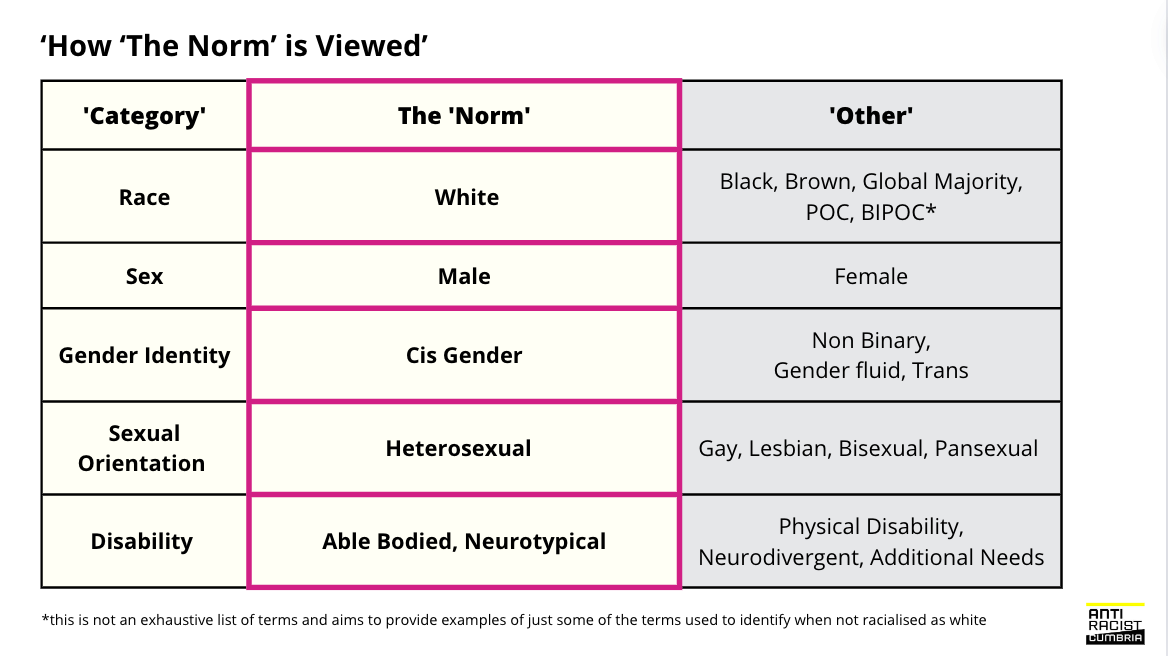
Time and time again it is those who are not the ‘accepted norms’ who are expected to do the work, to educate those who occupy the ‘norms’.
Yet it is not those of us who are ‘othered’ who are problematic, so why consistently look to us for solutions?
It’s been a long article so far, so I hope you are still with me and that you’re thinking about all of these things as you read. There’s not much longer to go now, so please keep at it.
Let’s look now at times when we do share. Often as I said above, it happens in the workplace, at an organised event, the purpose of which is billed as helping the workforce to learn from their colleague’s lived experience. I asked some of our Black and Brown members their thoughts on lived experience and being asked to share it. Here’s some of what they said:
“I also feel that in some situations where an experience is shared, it usually will have someone (usually a in white body) try and share back* an ‘experience’ that they had and one they feel resonates with mine. And that completely invalidates my experience but at the same time it’s made my colleague feel better. That one probably bothers me the most. It’s so important to actually listen if someone is sharing instead of trying to think of something to ‘make them feel better’ “.
“The unseen pain that is felt by sharing distressing experiences and the risks that are involved …whataboutery, being believed… is your lived experienced being respected or used as fuel for something else”.
“The gaslighting that often comes with [sharing lived experience] is extraordinary. The making you think you’re crazy or overreacting or not getting the humour is very disturbing. Treated as if you’re stupid or uptight. And only reignites the trauma. And just this general feeling of needing to “prove” my racial trauma or prove myself to people through my lived experience is tiring, to say the least. Always feeling the need to validate my own existence as if my just being in the space is not enough”.
Now ask yourself a question; do you prepare the workforce staff for the impact of someone sharing lived experience? Have you ever even considered the personal sacrifice that’s made to do this or the privilege your staff have of ‘learning’ through someone else’s suffering? What about managing victim blaming? Perhaps I can leave you to sit with that for a minute.
As Ijeoma Oluo says:
“The truth is, if sharing our painful stories were enough, we’d certainly have gotten everyone on our side by now. We would all be connected. We would all see our shared liberation. We’d all be fighting systemic oppression together. But instead, we keep tearing our wounds back open in hopes that the pain of what is never given time to heal will spur spectators to touch an old-healed scar of their own and decide to do something. Generation after generation we’ve done this. Countless articles, books, movies, plays, songs, re-traumatising ourselves, begging, pleading… maybe this time.. maybe this time…”
I want to finish by asking you not to get us wrong, there can be value in lived experience, and when handled sensitively it can help with influencing policies that have a longer term more sustainable impact.
But only when it’s done right and recognised for what it is.
Central to all of our work at ARC, especially policy, is that it is the voices of our communities most affected themselves that are the ones who drive forward real change.
ARC’s pioneering work through embodiment, self regulation, developing the tools to be resourced and to tend the wounds, ensures that the voices and experiences of Black and Brown people are not only heard but also acted upon, without causing the harm that often occurs when lived experiences are the sole focus. This approach avoids the pitfalls of traditional methods of ‘education,’ ‘learning,’ and ‘action’ that fail to be truly anti-racist.
There will be people out there who want to, for many reasons, share their lived experience (and that’s a whole other blog).
We’re not here to tell people they shouldn’t or can’t.
We’re simply telling you why we don’t as an organisation, and we’re asking you to think about what you can do if you are requesting lived experience to be shared; the first thing I’d expect you to do having read this article, before you do anything else is ask yourself ‘why do we even want to do this?’.
And if you still decide you’re doing it please do the following too; recognise racial trauma, have support in place both during and after, educate and prepare your audience to help reduce the harm. And value the person sharing by paying them – not just expenses but an actual fee – their lived experience is sadly a form of expertise, so treat them in the way you would other experts.
Alternatively, how about just working it out in other ways? I’ll leave you with another quote from Ijeoma Oluo’s blog – The Limits of Empathy (which I strongly recommend you click the live link and read by the way);
“We could just decide to believe people.”
* There are times when ‘share back in conversation’ IS appropriate. Many ADHD/Autistic people use share back to demonstrate understanding, empathy and connection and we are not advocating a ‘no share back rule’ in any circumstances. We are not here to ‘shut down’ one marginalised group in the pursuit of supporting another
