TW: This article references enslavement and uses some historical quotes with outdated, racist language.
My YouTube recommendations had pulled off another masterstroke. A new series of Pengame was pending for the public to watch, and the sounds in my earphones whisked me away to another world.
In this war of words, anything goes. Lyrical violence is part and parcel of the rap battles, and artists must display verbal wizardry with witty crowd control to conquer their opponents in the competition.
Here, you can see Black communities congregating to listen to artists without any boundaries placed on artistic expression. It is a shame to see that Britain continues to keep this creativity on a tight leash.


Despite the commercial success of many artists, rap remains a demonised element of Black British culture. Drill is a particularly notorious subgenre of rap that has been censored by radio stations, repeatedly removed from YouTube channels and blamed for the rising knife crime across London.
This is nothing new. Ever since high numbers of Afro-Caribbeans moved to Britain during the 1940s, politicians have presented them as a ‘public problem’ and a disorderly, threatening element of society. Decades later, those stereotypes still resonate in a nation where Black success is seen with scepticism.
Racism is more than isolated cases of discriminatory behaviour. It shows that whiteness is embedded as the norm in Britain’s social institutions. Throughout this article, keep asking yourself this question: who has the power and means to define what it means to be Black? The dominant representations of Black people allow us to see that this community have rarely been allowed to speak for themselves.
But removing racist representations of Black people from our society is not just about giving this community a seat at the existing table of power. It is more than calling out the racist stereotypes that surround them. It is about giving their humanity the space to breathe so we can embrace the trials and triumphs of a group of people that break any one image, past or present, of what it is to be ‘Black.’
While we are long way from that reality, grassroots communities have taken that task into their own hands. Institutions have tried to erase the significance of Black British people, but the past provides plenty of evidence for their existence and resistance. They have overcome the odds to become a big part of this country’s culture— and we can learn from this history of those who have come before us.
The Makings of a Mancunian Black community
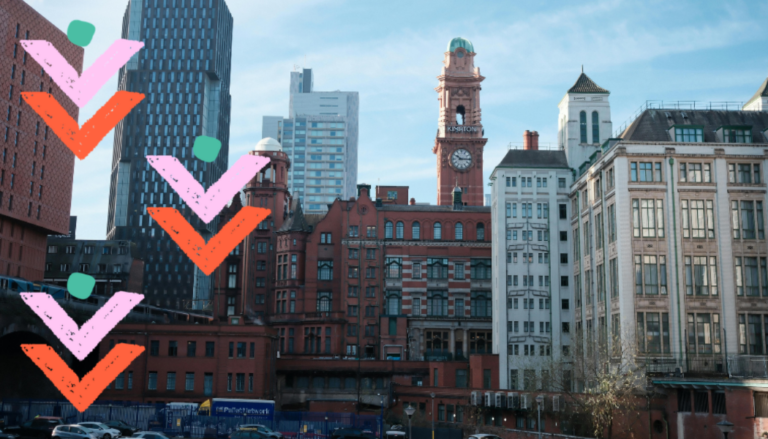
Manchester is the perfect place to bring this narrative to life. This year, the city hosts the 30th edition of the MOBO Awards, an annual British event that celebrates music of Black origin from across the globe. The founder of the presentation night, Kanya King, spoke about why Manchester was chosen:
“Music in Manchester’s DNA. From afrobeats to grime and drill, all of that and everything in between. It’s powerful, and the music has come a lot of the time from struggle.”
It is to the struggle that we shall first turn.
Manchester was one of the most prominent producers of textiles across the world, and its industrial development was built upon the back of the Transatlantic Trade in enslaved African people. Raw cotton was picked by enslaved Africans and then shipped to Mancunian mills. In order for the city’s economy to expand, Africans were denied their humanity and Black labour was ruthlessly exploited.
Industrialisation also brought Black people into direct contact with Manchester— especially because of the docks that allowed goods and enslaved Africans to be circulated during chattel slavery. The first settlements of Black migrants occurred in the mid-19th Century. By the 1920s, Greengate, one of Salford’s suburbs, housed a population of 250 Africans, Caribbeans, and Black Americans.
‘Little Africa’ was born, but it cannot be understood outside of this process of exploitation. To sustain chattel slavery, enslavers justified their actions through a racial ideology that took being white as the ideal form of human existence. Being Black, therefore, represented an inferior form of existence that did not deserve social respect. Those beliefs did not disappear when migrants moved to Manchester.
Racist representations of Africans and Caribbeans, who begun to settle in the city in greater numbers in the 1930s, were reinforced through the structures and systems of daily life. Black workers were almost only given roles of unskilled labour, and when they were promoted to skilled positions, they were often underpaid and misinformed about the remits of their roles. One train worker commented:
“I had to use my initiative a lot, because there was no book of rules, or more precisely, only a bare minimum book of rules, and nothing to say when the rules had to be bent or modified to keep the railway running. One of the things on which the rule book said nothing was which wagons had to go on which trains. I would get orders on the trackside phone to make up the Blackpool train and such, and if I asked for help, I was told, “You should know what to do.” They were trying to catch me out.”
If Black workers challenged their employers, they would be labelled as lacking the intelligence, talent and experience to deserve promotion in the workforce. If they remained in unskilled positions, they reinforced the notion that white workers were more capable of complex work tasks than their peers.
In a lose-lose scenario, Black workers were also forced to cope with worse housing opportunities. The interests of white, middle-class people were prioritised in Manchester as new, three-storey housing was built in the south of the city. Rich residents bought these new urban developments, leaving a mixed population of poor workers to make to do with whatever accommodation they could afford.
By the beginning of the 1940s, most of the Afro-Caribbeans present in Manchester had settled in the district of Moss Side. Black workers were pitted against poor white labourers in the search for housing, often living in rundown rental accommodation with little to no support from the local authority. The city had essentially abandoned its Black community and was willing to allow racist stereotypes about these people to become their reality. But Black Britain was ready to fight back.
Breaking the colour bar: How did political activists address inequality?
All these developments placed Black people in an impossible position. Only in a few cases could they point to iron cast rules that framed them differently to their white counterparts. For the most part, the ‘colour bar’ was informally implemented as a hidden norm that placed limits on their social mobility.
Because businesses did not enforce written rules to mistreat Black workers, it was harder for Black people to fight for their cause. This is one way that racist representations reinforced themselves through social structures: white employers had the freedom to frame the feelings and experiences of Black workers in a misleading way to benefit their interests. The law did not hold them accountable.
Racist narratives about Black migrants were not true, but they were an important part of the systemic oppression that tried to shackle this emerging community. This is why resistance remains a powerful tool in the fight against racism. It is a reminder that marginalised communities are not the puppets of their oppressors. They are people who refuse to be denied the right to stand up for themselves.
While no help was forthcoming from local government, the emerging Black community devised its own answers to the problem at hand. A key figure for the resistance in the city was Ras Makonnen. He was one of the individuals responsible for the Pan-African Federation (PAF), an organisation that brought together people based in Britain who wished for the liberation and unity of African people.
PAF believed in the concept of ‘Pan-Africanism’, a philosophy that suggested Black people had to work together to end racial discrimination. For Makonnen, a business minded individual, the situation in Manchester presented the chance to put the philosophy into practice. The 1940s saw the creation of pubs, nightclubs and bars exclusively for the Black community that were free from the ‘colour bar’— and they were popular with African Americans who served in Britain during the Second World War.
Makonnen himself set up a series of food chain restaurants along the top of Oxford Road, and he also went on to open a bookshop that shared content from Black radical magazines and pamphlets. The innovation and resourcefulness of the Black community slowly but surely forged a thriving leisure scene that centred the needs of its people. Thanks to this groundwork, other opportunities followed.
Profits from Makonnen’s ventures went into political work. The most famous example of this activism was the Fifth Pan-African Congress in 1945. Manchester’s connections with chattel slavery and the cotton industry made the city as a symbolic setting for Congress, but its selection was also practical.
There were a host of Black-friendly venues for travelling parties to attend, and Makonnen’s links to the Labour Party secured access to Chorlton-on-Medlock Town Hall as the venue for the event.
In the longer term, Manchester was marking out itself out as a home for different visions of Black liberationist politics. The culture of Afro-Caribbean migrants was becoming a more visible part of British life, and the country could not hide the significance of its Black community for much longer.
From fascination to fear: Britain’s battle with Black performers
The battle for Black liberation did not stop at public policy and politics. This community continued to challenge racist representations in society through the jazz culture that took a grip of Manchester.
Jazz was to the 1920s and 1930s what drill became in the 2010s. The creation of African American musicians, this was a fresh and lively artform that gained the interest of young people in Britain. But the country’s fascination with jazz was not always well-intentioned. One musical critic commented:
“It is my belief that the development of Jazz will come from the [Black] race: [white people] lack the spontaneity of [Black] people and innate feel for the jazz idiom. Their playing is characterized by its extreme fervour; these [Black] artists subordinate every feeling to the job in hand.”
On the one hand, there was a rising appreciation for the improvisation of jazz music that could create different sounds from the rigid forms of classical music that dominated at the time. But this praise was still rooted in racist representations of Black people. The assumption here is that Black people had primitive, animalistic qualities that would give their performances more ‘spontaneity and ‘fervour.’
This idea of ‘Black’ entertainment, previously captured by minstrels and blackface, appealed to white consumers. It was an image to be manipulated and mocked. But real Black people were not meant to become celebrated figures in society. Fascination became fear at the point that Black communities had the power to platform their talent, and musicians were frequently stopped from performing their work.
“When the minstrel can wash his race off after office hours, he is harmless; but the true [Black] artist is often a dangerous fellow to be let loose in a hall – we dare not be so familiar with him.”
In this way, the art was to be separated from the artist. Black jazz artists from the USA and Britain had to find work in the underground scene of nightclubs, while entertainment venues and BBC broadcasts tasked white bands with civilising the craze for jazz music. To put it simply: Britain was willing to accept the ‘rhythms’ of a Black cultural experience without addressing the ‘blues’ of social injustice.
Racist representations of Black jazz were also framed in moral terms as white media was worried that it could corrupt the public. But by the 1940s, the actions of the Black community in Manchester were making more Black musicians known to locals and making a mockery of jazz’s most vocal critics.
When African Americans served in Britain, they brought their culture to Black entertainment venues in the city. Servicemen knew dance styles and record collections that allowed local Mancunians to get familiar with ‘authentic’ jazz from the USA. And after the Second World War, Caribbeans, who kept coming to Manchester, brought their appreciation of Black jazz. From their native islands, they also transported another dimension to this cultural melting point: a love of loudspeaker sound systems.
Now all the pieces were in place for a trendy party culture that filled coffee bars and youth clubs. A lively leisure scene, radically different from the sedentary pub culture of Britain, brought warmth and familiarity for migrants whose culture was flourishing. Even more impressively, spaces that were created for Black comfort and retreat had formed the foundation of a hip ‘alternative’ party scene.
This was truly a display of ‘multiculturalism’, a possibility driven by a community never meant to have a say in the storyline. Black Britain was surviving and stepping into the mainstream. But let it not be forgotten: Black superstardom was an idea fundamentally frowned upon by people in power.
The more things change, the more they stay the same
History has its own musicality that brings us back to the present day. It is often said that history does not repeat itself, but it does rhyme. The conflicts between British authorities and popular Black musical genres have hardly changed in content as their game of cat-and-mouse continues to evolve.
During the last decade, Black British musicians have come up against even more draconian policies. From the racially coded risk assessment Form 696 to undercover monitoring of drill artists through Project Alpha, authorities have harnessed the power of the police in a big way to try to restrain the popularity of new forms of Black British music. It is explicitly being weaponised and criminalised.
History has shown that authorities have spun the truth to take this stance. Those who frame Black people as a threat to public safety have shunned responsibility for their abandonment— be it in Moss Side or today’s inner-city London. Those who take the lyrical violence of grime and drill literally illustrate how the image of the ‘dangerous fellow let loose in the hall’ still haunts people in power.
And so little has changed. Britain has not confronted its history head-on. The white media knows this, and as a 1956 Daily Mail report reveals, society has been held hostage to the anxieties from its past.
“[Rock and roll] has something of the African tom-tom and voodoo dance [about it]. It is deplorable. It is tribal. And it is from America. It follows ragtime, dixie, jazz, hot cha-cha and boogie-woogie, which surely originated in the jungle. We sometimes wonder whether it is the negro’s revenge.”
Our deepest fears can forge the monsters that we make of others. The racial representations we see in British society are in essence a contradiction: Black people have been typecast through narrow images meant to disempower them and yet their qualities are always presented as something to be feared.
Though the resistance of the Black British community is certainly to be respected, fear is not the answer. Blackness is a bogeyman that has been socially constructed, and Britain must be willing (for once) to work through the messiness of misrepresenting its past to produce a fairer future for all.
In the mood to listen to come music? Emmanuel recommends…
💥Dizzee Rascal: World Outside (2007)
💥Akala: Find No Enemy (2011)
💥Skepta: Shutdown (2015)
💥Big Zuu: Warmup Sessions [S9:EP43] (2016)
💥J Hus: Spirit (2017)
💥Novelist: Stop Killing the Mandem (2018)
Kano: Good Youtes Walk Amongst Evil (2019)
💥Double Lz, Bandokay and OFB: BLM (2020)
💥AJ Tracey & Unknown T: Black and Proud (2020)
💥Jammz: Rebellious (2022)