
 This article was written by Shabnam Anam and is also shared on her Medium blog page.
As we see the events in Palestine further escalate and the world’s governments, citizens and media stake their claims either side, calls of antisemitism, terrorist sympathies, ethnic cleansing, and colonial violence echo on a loop.
Understanding the difference between and within Jewish people, Zionists, anti-Zionists, and antisemitism is crucial to understanding the ideology and power structures behind the violence that has and is taking place in that part of the world. And while we can agree that genocide is not a complex matter, the context is steeped in ambiguity, misinformation and weaponization.
So, do all Jewish people support ‘Israel’?
When Rishi Sunak made his speech in support of Israel, he made it sound as if the attacks of Hamas were a direct attack on Jewish people collectively and “an existential strike at the very idea of Israel as a safe homeland for Jewish people.” His conflation of Israel with all Jewish people as a ‘community’ and his neglect in separating Hamas from all Palestinians, demonstrates this kind of historical, political, and ideological ignorance.
On the surface it may seem right to make these connections: Israel is home to half of the world’s Jewish population, and it is the world’s only Jewish state. Hamas does espouse deeply antiSemitic rhetoric and employs acts of violent resistance but if you take a deeper look, you will see that Jewish people have been divided on the subject of a ‘homeland’ for a long time and that Zionism relied heavily on settler colonial logic and the and ‘elimination of the native’.
So, what exactly is Zionism? Zionism is the movement that supported establishing this homeland for Jewish people, who were displaced over generations across the world. The place that was chosen was Palestine. Why? Because the region roughly corresponded to ‘The Land of Israel’ that is held in Jewish tradition.

Theodor Herzl
In 1890, the founder of the first Jewish student association, Nathan Birnbaum coined the term ‘Zionism’ and a few years later Theodor Herzl, published his proposal Der Judenstaat (The Jewish State), written in German, in 1896. Written in the face of increasing antisemitism in Northern Europe, Herzl’s writing was considered the founding document for the Zionist movement.
However, not all Jewish people agreed and there were many examples of Jewish anti-Zionism. In the late 19th Century, Orthodox Jews denounced Zionism as sacrilegious. Later, Russian Bundists, a Jewish socialist workers movement, argued it would be better to fight against the rampant antisemitism in Europe and demand better conditions within the diaspora than create a sperate state in order to liberate Jewish people.
There are many Jewish people who understand that Israel, as a nation state, has taken Palestine through ruthless and violent colonial means and they oppose the Zionist disregard for law, justice and morality. There was no cooperation with the indigenous Arab population and the only way to realise ‘Israel’ was to drive out those communities and take over the land. Something that the British government made possible through The Balfour Declaration, drafted by Lord Rothschild, head of the Jewish European banking family and sent to foreign minister, Lord Balfour in 1917.
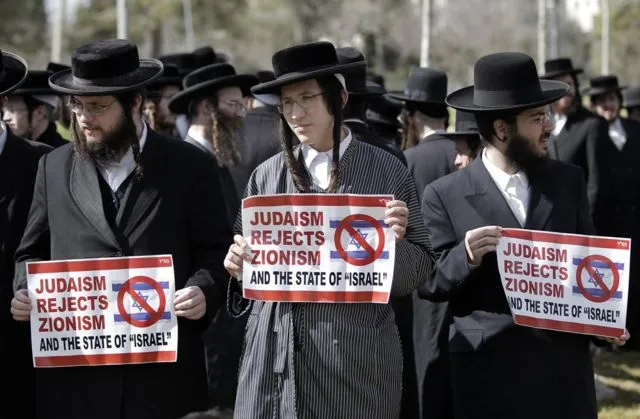 Definitions of Zionism in the Jewish community are now varied and not entirely clear. A survey in 2015 showed that 90% of Jewish people in the UK believed in Israel’s right to be a Jewish state but only 59% of those people would identify as Zionists. For some, Zionism means a belief in a Jewish state, in a national liberation movement, but for others it is about continued violent displacement, occupation, colonisation and ethnic cleansing. Here in the UK, Jewish anti-Zionists belonging to a range of groups have recently been seen joining people in protests for Palestinian freedom even when they themselves have been grieving family members killed in the region. They recognise that the expulsion of Palestinians from their homeland, the genocide, the very act of it as well as its legacy is something that Jewish people cannot disconnect from their own experiences.
But those standing with Palestine and refusing to ‘stand with Israel’ have been considered antisemitic in their anti-Zionist stance. This is often centred around a notion that these two things are deliberately considered as one to discredit any kind of opposition to Israeli actions and policy; or that if you are anti ‘Israel’, you stand against the Jewish community, against Judaism. Both of these arguments have been weaponised and its easy to see how they seem plausible. But if we’ve established that Zionism has no singular interpretation, then the same has to apply to anti-Zionism.
Let’s think about the actual State of Israel. Israel is what’s known as an ethno-religious state – a state founded on cultural and religious beliefs. There are two important questions to be considered here. Do people have a right to land because of their religious and cultural connections? Does anyone have the right to deny the existence of those connections and how important they are to identity? The answer to both is no. So, with that in mind we can see how denying national rights for Jewish people can be taken as antisemitic, particularly when our nationalities are often important in establishing and validating our identities. Plus, the state of Israel already exists, no matter how it came to be. However, we can’t ignore the fact that ‘nations’, new and old are not formed along lines of equity, they are often established through intentional violence and unjust actions. Israel’s vision is being realised and built on the decimation and displacement of another people – Palestinians.

Great Britain as Palestine by Jordan Engel
The disparate interests and positions of power, particularly of the West, involved in this political situation mean that it is never going to be easy to disconnect these terms, but neither should it mean that the important aspects, the very real humanitarian crisis, the terror and violence in Gaza, be obfuscated by rhetoric and highly charged labels.
